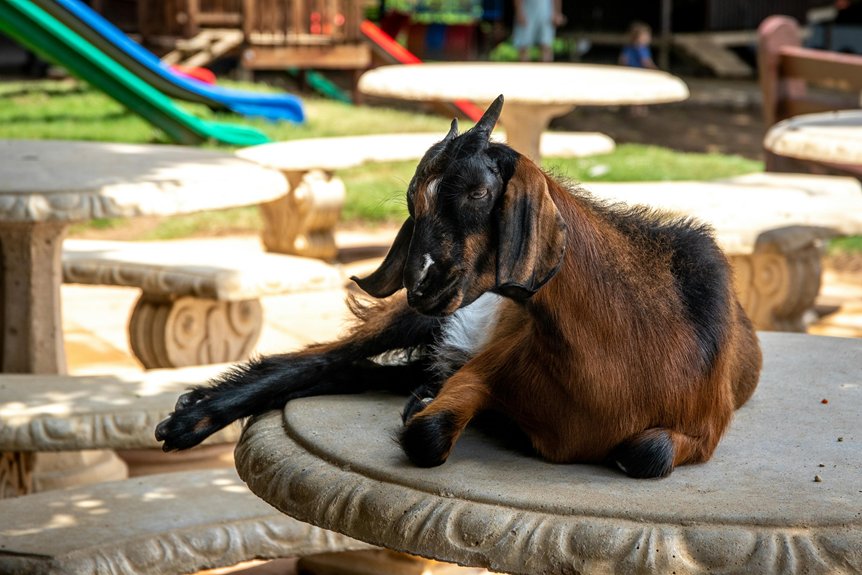
You can keep backyard goats, but local zoning laws and municipal ordinances—not state law—determine your property’s eligibility. Contact your city planning department for written guidelines specifying breed restrictions, housing requirements, setback distances, and minimum enclosure sizes. Most regulations require a three-walled shelter with proper drainage, secure fencing with multi-wire components, and at least 400 square feet per two goats. Expect inspection requirements and potential penalties for non-compliance. Understanding these prerequisites before acquiring goats allows you to establish a compliant, sustainable setup.
Check Your Local Zoning Laws and City Ordinances
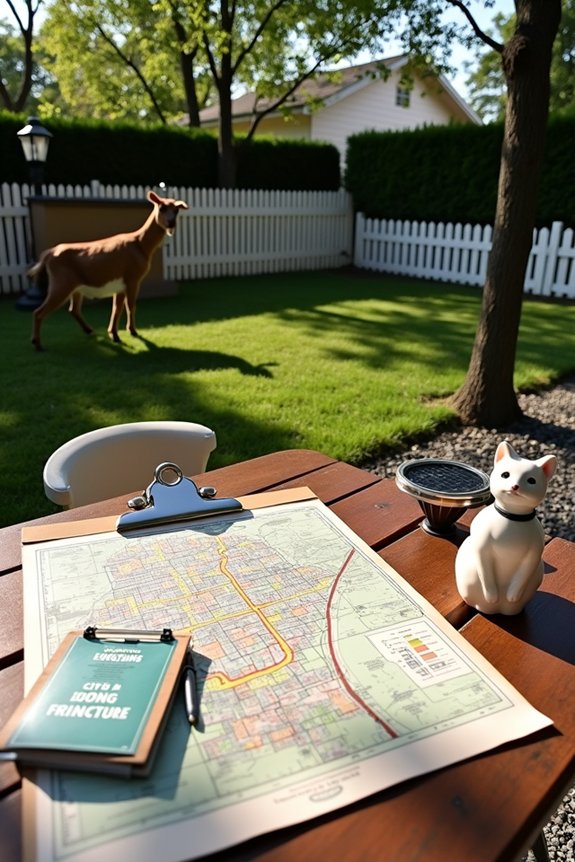
Before you bring home your first goat, you’ll need to check your local zoning laws and city ordinances—they’re what’ll actually determine whether backyard goat-keeping is legal for you. State law alone won’t settle the question. Your municipality establishes the specific regulations governing livestock in residential areas. San Diego, for instance, permits two miniature goats for single-family residents. Your local laws might mandate particular breeds—miniature, pygmy, or dwarf varieties. They’ll specify housing requirements too. You’ll need a shed and outdoor enclosure meeting setback distances and minimum size specifications. Males often require neutering, and disbudding may be mandatory. Contact your city planning or zoning department directly. They’ll provide written guidelines for your neighborhood. Don’t assume your neighbor’s setup means yours is permitted—regulations vary drastically across jurisdictions.
Understand the Real Costs of Goat Ownership
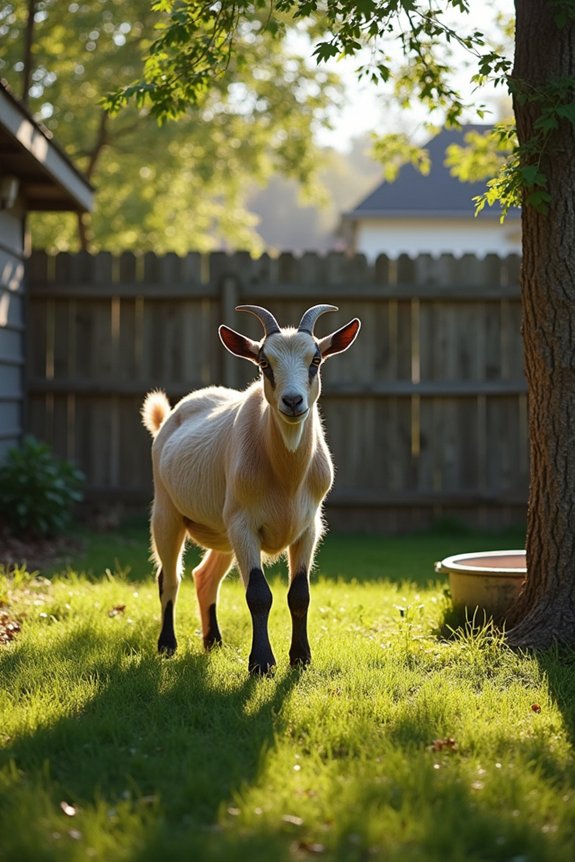
How much will backyard goat ownership actually cost you? I’ve found that goat owners must budget for several essential expenses beyond the initial purchase price. Goats need consistent investment across multiple categories:
- Housing and fencing: Multi-wire fencing systems with electric components and proper earthing run $1,500–$3,000. Shelter structures require weatherproof roofing, ventilation, and predator protection measures.
- Daily care supplies: Feed, bedding, and water systems demand $50–$100 monthly per pair. Milking equipment for dairy breeds adds another $200–$500 upfront.
- Health and maintenance: Annual veterinary care, vaccinations, and hoof trimming cost $300–$600 per animal.
Goat owners should anticipate $2,000–$4,000 in first-year costs. Ongoing annual expenses typically reach $1,500–$2,500 for proper management. These figures support adequate housing, nutrition, and healthcare standards.
Choose the Right Breed for Your Space
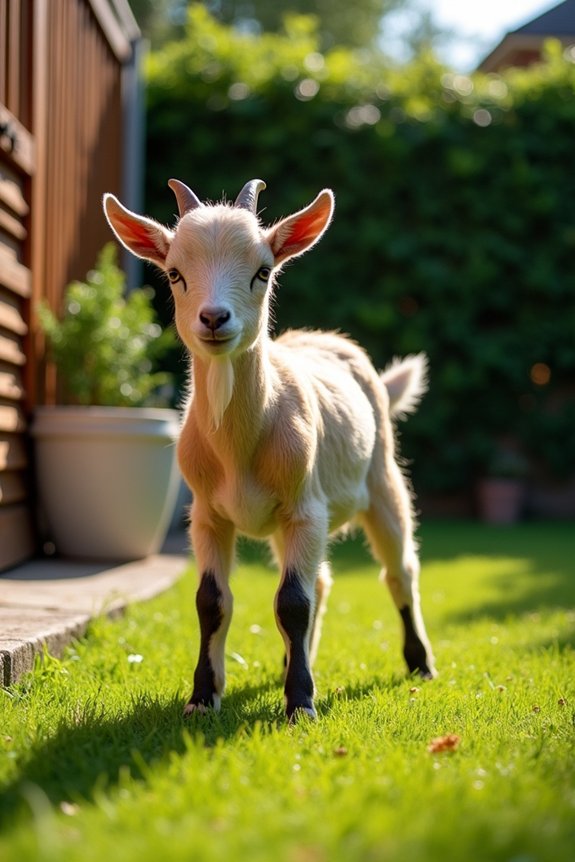
When selecting a goat breed, you’ll need to match the animal’s mature size and space requirements to your backyard dimensions and production goals. Nigerian Dwarf goats thrive in smaller yards and suit dairy or show purposes, while standard breeds demand notably more acreage and resources. Beyond space considerations, you should evaluate horned versus hornless genetics, temperament traits, and handling difficulty—factors that directly influence safety, especially with children present.
Matching Breed To Space
Selecting the right goat breed depends on matching their size and temperament to your available land, shelter capacity, and management goals. Evaluate your space planning requirements before committing to any breed.
- Nigerian Dwarf goats suit small backyards with limited acreage; they weigh 50–75 pounds and require minimal feed resources.
- Alpine and Saanen breeds demand larger paddocks and more intensive management; they produce higher milk volumes for serious dairy operations.
- Meat breeds like Boer goats need adequate pasture for grazing and weight development; they’re heavier and require robust fencing.
Your goats need divided paddocks for rotational grazing and predator-protected shelters. Space planning determines whether you’ll manage two Nigerian Dwarfs or a single larger breed. Match breed selection to your actual land availability, not your aspirations.
Size And Production Goals
Your production goals—whether dairy, meat, fiber, or companionship—directly determine which breed fits your space and management capacity. If you’re considering dairy goats, understand that lactating females require milking twice daily, every single day. This commitment demands a functional goat shed with proper sanitation infrastructure and milking equipment. Nigerian Dwarf goats produce smaller milk volumes but suit compact backyards under one acre. Standard dairy breeds like Saanens or Alpines generate higher production but need expanded grazing space and sturdy facilities. Meat-focused operations require different breed selections entirely, favoring faster-growing animals. Fiber breeds demand specialized shearing equipment and handling knowledge. If companionship drives your decision, any healthy breed works—provided you maintain a minimum two-goat herd for social stability. Calculate your actual daily availability against production demands before selecting your herd.
Temperament And Handling Needs
How compatible is your household with a goat’s natural herd behavior and handling requirements?
Your temperament expectations directly influence which breed fits your backyard setup. Consider these key factors:
- Herd dynamics: Goats require at least two animals to prevent stress and escape behavior, demanding space and social structures you can maintain consistently.
- Hornless breeds: Choosing hornless varieties reduces injury risk during handling and makes management safer for children and family members working with them daily.
- Male selection: Uncastrated males display aggression and strong odors, so castrated males from smaller breeds like pygmy goats function better in residential settings.
Temperament varies significantly by breed and individual animal. Hornless goats typically display calmer dispositions during routine handling. Your commitment to twice-daily milking routines—if selecting females—further determines whether your household can accommodate their behavioral and physical demands sustainably.
Build Secure Fencing and Predator-Proof Shelter
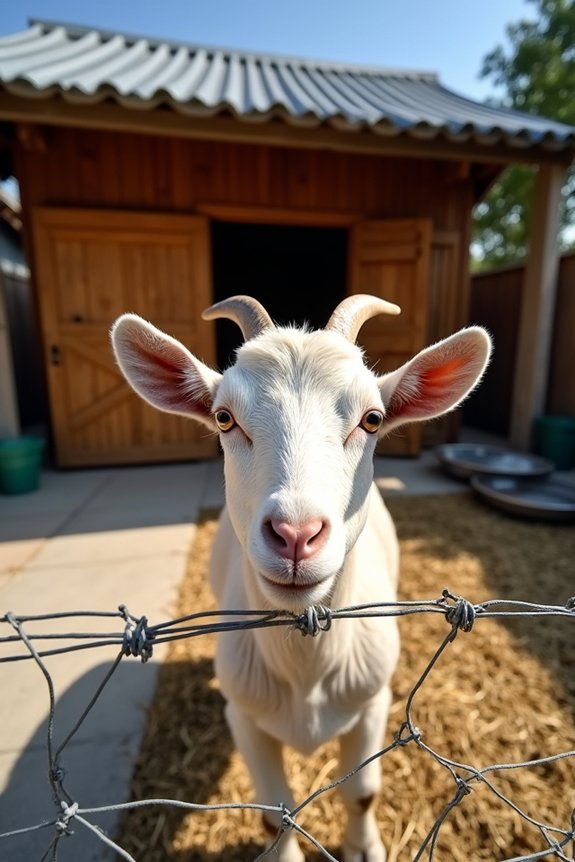
What separates a successful goat setup from a chaotic one? Secure fencing and a predator-proof shelter. I’d recommend cattle panels or multi-wire fencing to prevent escapes and deter predators effectively.
Your goat shelter requires three walls, one open side for ventilation, and a predator-proof door. Position it on higher ground to avoid soggy conditions. The outdoor enclosure needs proper drainage and at least 400 square feet per two goats.
| Component | Material | Function |
|---|---|---|
| Perimeter fence | Cattle panels | Containment and predator deterrence |
| Shelter walls | Wood framing | Weather protection and structure |
| Fencing system | Electric and non-electric wire | Enhanced security and safety |
Combine electric and non-electric wires with proper earthing to prevent electrical shocks. This integrated approach keeps your goats secure while you maintain control over their environment.
Plan Your Goat’s Diet and Water System
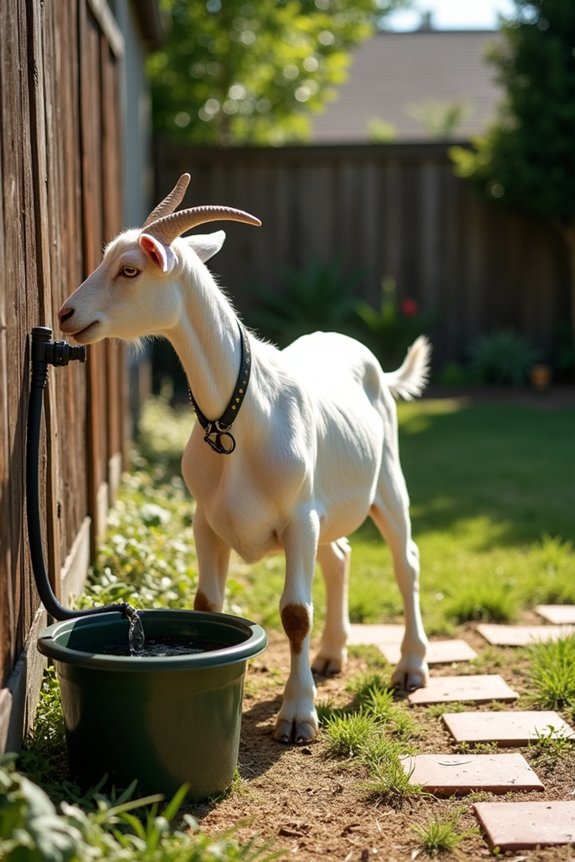
Once you’ve secured your shelter and fencing, you’ll need to establish a reliable feeding and watering system that keeps your goats healthy and your backyard manageable. I recommend installing hanging feeders constructed from metal or durable plastic to prevent tipping and contamination, paired with a consistent water supply delivered through automatic waterers or refillable troughs positioned away from hay storage. Your goats will thrive on browse—leaves, shoots, and fresh vegetation—supplemented with dry hay and stored grain, though you’ll need to monitor feed quality closely and arrange regular hay deliveries as your herd expands.
Browse and Forage Options
Successfully planning your goat’s diet requires understanding their natural browsing behavior and establishing a reliable feeding infrastructure. Goats thrive on browse—leaves and shoots from woody plants—which constitutes their primary nutrition source. I recommend supplementing with fresh, dry hay to maintain consistent nutrition year-round.
Here’s what you’ll need to implement:
- Browse availability: Plant diverse woody vegetation like willow, oak saplings, and fruit tree branches to encourage natural foraging behaviors
- Hay selection: Source quality dry hay exclusively, avoiding moldy or wet bales that compromise herd health and goat milk production
- Feeding structure: Install hanging feeders to prevent tipping and contamination while reducing waste
Delivering large bales when possible decreases feeding frequency and labor demands. This balanced approach supports optimal nutrition while aligning with your goats’ instinctive feeding patterns.
Water Supply and Equipment
Your goats’ water infrastructure directly impacts their health, milk production, and daily management efficiency. Establishing a reliable water supply requires planning for both immediate needs and future herd expansion. Clean water equipment prevents dehydration and supports consistent milk production in dairy operations.
| Water Equipment | Purpose |
|---|---|
| Hanging waterers | Minimize ground contamination, reduce waste |
| Stainless steel buckets | Easy cleaning, durability, hygiene |
| Backup containers | Provide supply during equipment failure |
| Properly maintained tanks | Support herd growth capacity |
Maintain waterers at appropriate heights, allowing easy access without spillage. Redundancy in your water system prevents shortages during drought periods or high-output seasons. Stainless steel buckets withstand frequent cleaning and resist corrosion. Regular equipment maintenance keeps your system functioning reliably, supporting your goats’ consistent hydration and production needs throughout the year.
Decide Between One Goat or a Herd
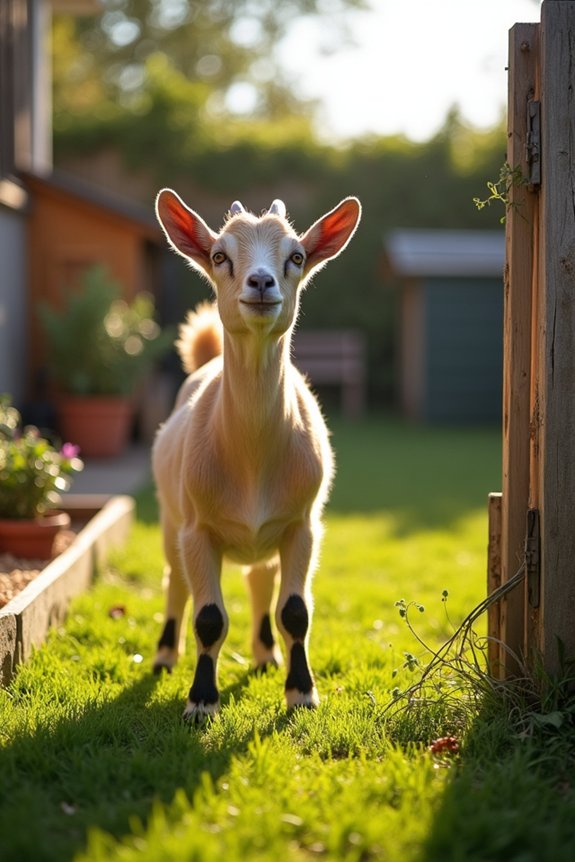
How many goats should you actually keep on your property? The answer depends on your space, local regulations, and commitment level.
Goats are herd animals and require companionship to thrive:
- Minimum of two goats prevents stress, escape behavior, and psychological distress in your herd
- Space requirements include a paddock divided into sections with seven-wire electric fencing at approximately two meters height for predator protection
- Local ordinances may mandate miniature goats in urban areas like San Diego, with specific setback distances and enclosure specifications for single-family residents
A pair produces up to half a gallon of milk daily, depending on breed and lactation cycles. Consider your available acreage, fencing infrastructure, and ongoing care capacity before deciding. Keeping goats alone creates welfare issues that complicate management and contradict their social nature.
Set Up a Basic Health and Hoof Care Routine
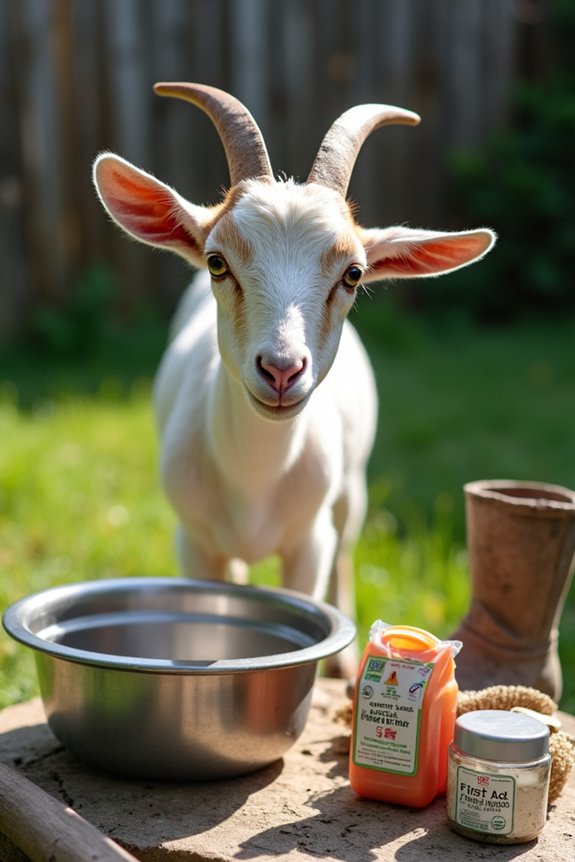
I need to establish hoof trimming schedules and disease testing protocols before bringing goats home. Regular hoof trimming prevents overgrowth and hoof rot, requiring monthly maintenance with proper trimming tools. I’ll also schedule annual herd testing for disease detection, consulting a veterinarian to create a baseline health plan.
Regular Hoof Trimming
Why neglect an essential maintenance task that directly prevents lameness and mobility issues in backyard goats?
Regular hoof trimming keeps your goats healthy and functional. I trim hooves every 6–8 weeks using sterilized clippers, cutting only the outer hoof wall to avoid the quick. This prevents bleeding and pain while maintaining proper hoof structure.
During each trimming session, I:
- Inspect hooves for overgrowth, cracks, infections, foot rot, and sole ulcers
- Rasp uneven edges to create a smooth, level sole
- Document observations to track individual goat health patterns
I monitor for persistent lameness or uneven gait between sessions. Catching problems early prevents serious complications. Consulting a veterinarian addresses abnormalities promptly. Consistent hoof care directly supports your goats’ mobility and overall wellbeing, making it a non-negotiable aspect of responsible backyard goat ownership.
Disease Testing Schedule
Disease testing schedules form the backbone of preventive herd health management. I schedule annual disease testing to detect illnesses early and maintain comprehensive health records for each goat. This proactive approach protects my entire herd from spreading contagious conditions.
I work with a veterinarian to establish testing protocols tailored to my region’s disease risks. Common tests screen for brucellosis, tuberculosis, and caprine arthritis encephalitis. Regular disease testing identifies infected animals before symptoms appear, allowing immediate intervention.
I document all test results, vaccination dates, and health observations in a centralized record system. This documentation tracks herd health trends and supports breeding decisions. I separate bucks and does outside breeding periods to reduce disease transmission risk.
Consistent disease testing combined with vaccination maintenance creates a robust health framework for backyard goats.
Know When Goats Become a Nuisance Problem
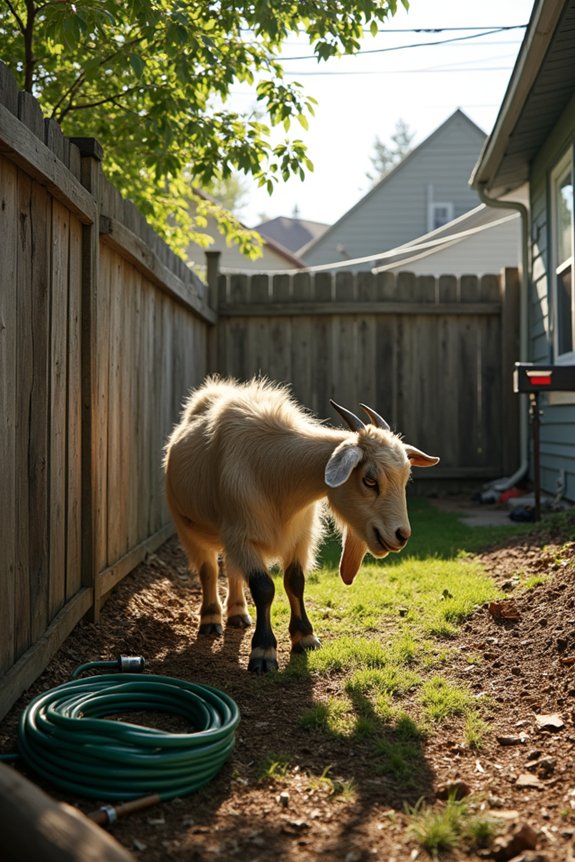
When does a backyard goat transition from manageable livestock to neighborhood problem? Understanding goats’ nuisance potential helps you assess whether backyard goats fit your situation.
Several factors determine if your animals become problematic:
- Noise and odor issues: Uncastrated males emit strong odors and vocalize frequently, disturbing neighbors within audible range. Lactating females require twice-daily milking schedules that disrupt quiet residential hours.
- Structural damage: Goats test fences relentlessly. Without 2-meter-high barriers, they escape into adjacent properties, destroying gardens and landscaping. Castrated males possess sufficient strength to breach inadequate enclosures.
- Social requirements: Keeping single goats creates behavioral problems. Herd animals need minimum two individuals for proper socialization, multiplying noise and resource demands.
Assess your property size, neighbor proximity, and commitment level before acquiring backyard goats.
Find Reputable Sellers and Transport Your Goats Home
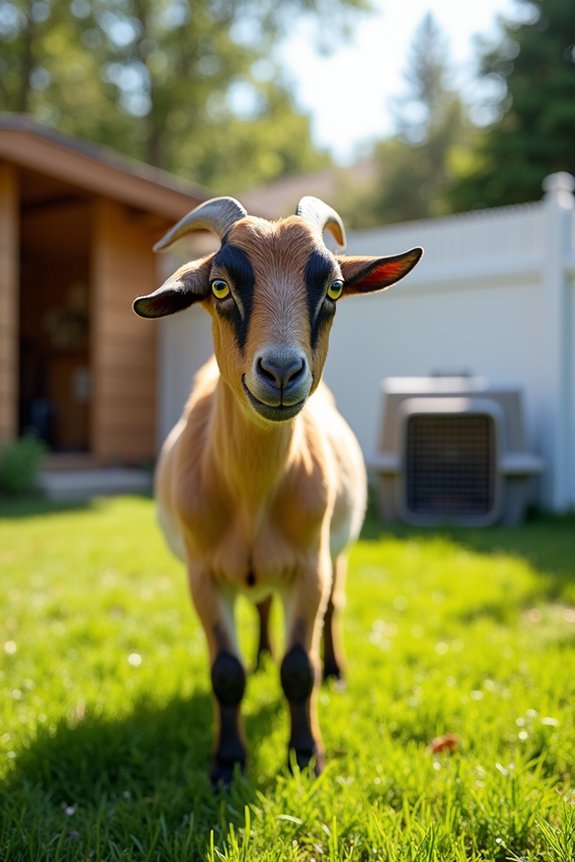
Once you’ve determined that backyard goats suit your situation, locating a trustworthy seller becomes your next step. I recommend checking local goat groups and goat breeders’ farm websites. Review customer feedback to assess herd health and transparency about disease testing. Request registration certificates and pedigrees if you’re showing competitively or purchasing high-value animals.
| Selection Criteria | Transport Requirements | Post-Arrival Care |
|---|---|---|
| Vaccination history | Dog cages or trailers | Comfortable sleeping area |
| Disease test results | Hay and water access | Accessible food supply |
| Breed verification | Shelter during transit | Calm acclimation environment |
Before transport, confirm interstate or intra-state regulations. Arrange appropriate containment with shelter, hay, food, and water for the journey. Upon arrival, I provide a comfortable sleeping space and accessible resources. This approach helps your new goats acclimate successfully to their backyard home.
Connect With Local Goat Owners for Ongoing Support
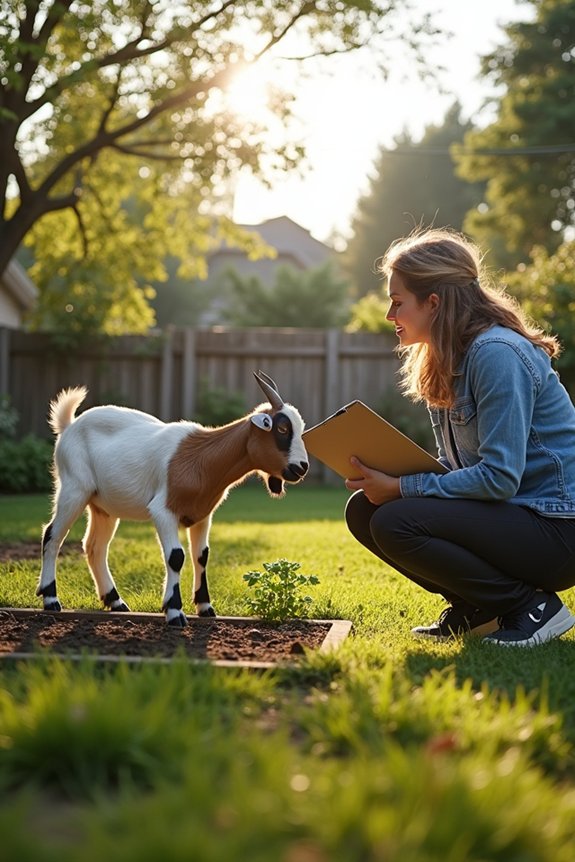
How do you find reliable guidance when you’re raising backyard goats for the first time?
Connecting with local goat owners gives you ongoing support that improves your experience. You’ll gain access to practical knowledge about feeding schedules, confinement systems, and daily routines specific to your region. Local networks provide key advantages:
- Breed recommendations and health verification – Experienced owners introduce you to reputable breeders and conduct initial health assessments for potential herd additions.
- Predator protection strategies – Peers share fencing specifications, enclosure designs, and proven defense mechanisms for your specific location.
- Community troubleshooting – Farm visits and online discussions address behavioral concerns and welfare issues with real-time feedback from established keepers.
Your local goat community understands zoning regulations, space constraints, and seasonal challenges affecting backyard operations. This ongoing support network helps you make informed decisions aligned with best practices and local standards.