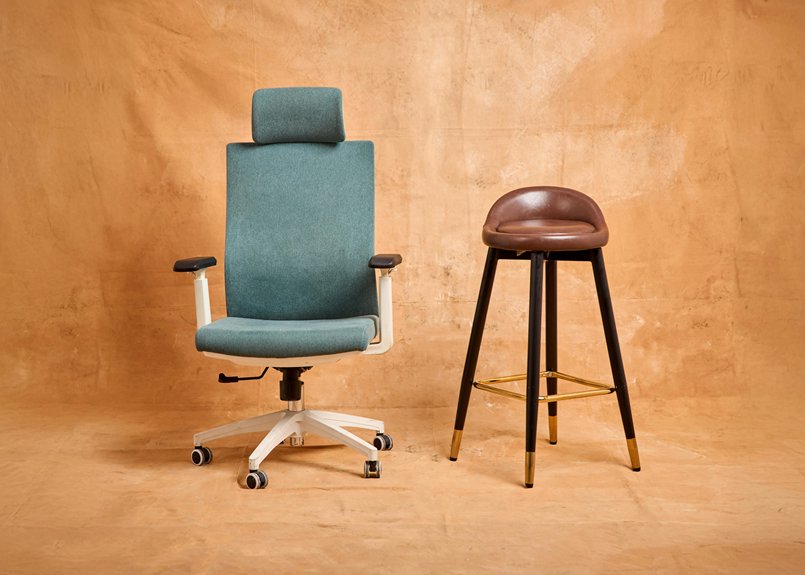
Office chair wheels aren’t truly universal despite what marketing suggests. About 95% of chairs use standardized 7/16 inch diameter stems, but stem length, socket depth, and mounting type vary considerably across manufacturers. IKEA uses proprietary 10×22 mm stems incompatible with standard 11×22 mm bases. You’ll encounter grip ring, grip neck, and threaded stem designs, each requiring specific socket engagement. Forcing mismatched stems causes wobbling and locking failures. Measuring your stem dimensions and mounting type before purchase prevents costly mistakes. Understanding these mechanical specifications reveals why brand-specific replacements often become necessary.
What “Universal” Actually Means for Office Chair Wheels?
When you’re shopping for replacement office chair wheels, you’ll encounter the term “universal” repeatedly—but it doesn’t mean what most people assume. Universal casters actually refer to standardized stem dimensions: 7/16 inch diameter and 7/8 inch length. About 95% of office chairs use this exact stem specification, making compatibility straightforward for most setups.
However, universal doesn’t guarantee automatic fit. Your caster’s stem must match your chair base’s mounting type and diameter precisely. The remaining 5% of chairs feature non-standard stems like 10 mm x 20 mm configurations, which won’t lock into standard bases.
Beyond stem compatibility, wheel size and material vary significantly. These factors affect floor performance and mobility characteristics. You’re joining the majority of users when selecting standard replacements, but verification remains essential before purchasing.
Standard Stem Sizes: 10×22 Mm vs. 11×22 Mm
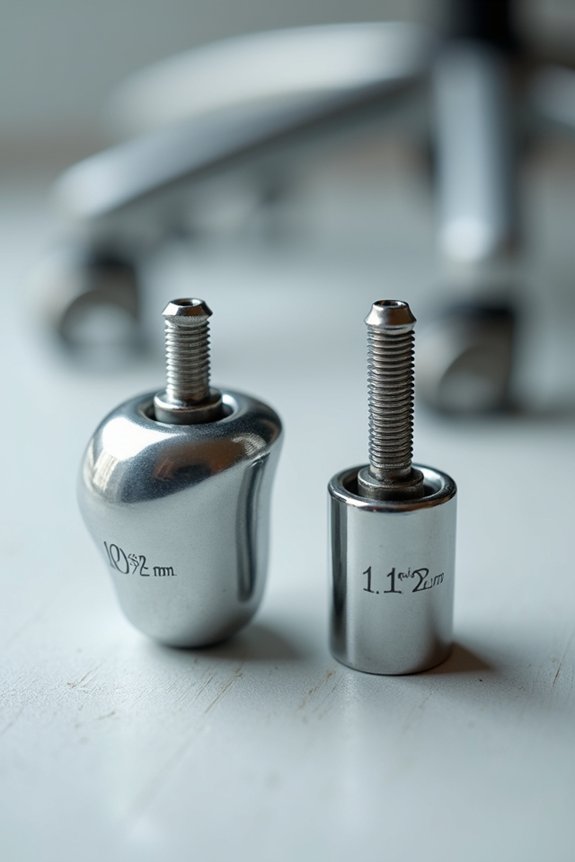
While universal compatibility covers most office chairs, the devil’s in the millimeter-level details. I’ve found that stem size represents the critical factor determining whether your replacement casters actually fit. Most manufacturers use either 10×22 mm or 11×22 mm stems, and this one-millimeter difference creates significant compatibility issues. Universal-fit casters typically accommodate the standard 11×22 mm specification, which explains why IKEA chairs—featuring non-standard 10×22 mm stems—require specific replacements. Forcing a 10×22 mm stem into an 11×22 mm base produces wobble and compromised locking mechanisms. I recommend measuring your chair’s stem diameter before purchasing replacement wheels. Confirm your base accepts that exact stem size. This verification step prevents compatibility problems and maintains proper function and safety.
Why IKEA and Other Brands Use Different Stems

Why do manufacturers like IKEA deliberately deviate from the standard 7/16 × 7/8 inch stem specification? They’re prioritizing compatibility with their proprietary base systems. IKEA uses 10 mm × 20 mm stems instead of the universal 11 mm × 22 mm standard. This design choice allows their wheels to fit their specific chair models without issues. Manufacturers adopt non-standard stems to control the entire assembly experience. They design bases around custom stem dimensions, creating integrated systems. This approach prevents compatibility problems within their product lines. However, this strategy limits your replacement options significantly. Non-standard stems mean you can’t easily swap wheels between brands. You’re restricted to brand-specific replacements, which increases costs and reduces flexibility. These design decisions prioritize internal compatibility over universal standards adherence.
Measure Your Stem Before Buying Replacements

How do you know if your replacement wheels’ll actually fit your chair? Before purchasing new casters, you’ll need to measure your current stem to verify compatibility. Stem measurement determines whether your replacement wheels’ll function properly with your base. Here’s what you should do:
- Measure the stem diameter using calipers or a ruler
- Record the stem length from base to tip
- Identify your current mounting type (stem versus plate)
- Note any floor-specific requirements for your workspace
Most office chairs use the standard 7/16 inch diameter and 7/8 inch length stem. However, IKEA and other manufacturers produce non-standard dimensions like 10 mm x 20 mm. Matching both diameter and mounting type is necessary for proper fit. These specifications directly affect how your replacement wheels perform and feel on your flooring.
The Three Stem Types You’ll Encounter

Your office chair’s caster stem determines how replacement wheels attach to the base—and there’s more variation than you’d expect. Understanding these stem types helps you avoid costly mistakes.
The grip neck features a wide base that tapers to a narrow head. This head inserts directly into your chair’s socket, relying on friction for retention. The grip ring operates differently—it uses a groove at the stem top where a split steel ring snaps into place. This mechanism provides more secure installation than grip neck designs.
Threaded stems screw into concave sockets, offering the most stable connection. You can reinforce them with nuts and washers for additional stability. Each stem type requires matching replacement wheels, making identification necessary before purchasing.
Socket Depth and Mounting: The Sneaky Compatibility Culprits

You’ll notice that socket depth—the interior measurement from the chair base opening to the bottom—determines whether your stem fully engages and locks securely. I find that many compatibility failures stem from depth mismatches: a 7/8 inch standard stem won’t seat properly in a socket designed for 5/8 inch insertion, even if the diameter fits. Understanding whether your chair uses a stem socket or plate-style mounting fundamentally changes which casters will actually work.
Socket Depth Measurement Matters
Why does a caster stem sometimes fail to seat properly even when its diameter matches your chair base’s socket? The answer lies in socket depth—a measurement that directly determines whether your stem fully engages the base.
Measuring socket depth prevents compatibility issues. Consider these critical factors:
- Stem diameter alignment alone won’t guarantee proper seating without adequate socket depth
- Socket depth variation across chair manufacturers creates incompatibility despite matching stem sizes
- Mounting type compatibility requires both diameter and depth verification for secure connection
- Bottoming out or gap formation occurs when socket depth mismatches stem length specifications
When you replace casters, verify socket depth alongside stem diameter and mounting type. This measurement keeps your wheel’s stem fully engaged without wobble, misalignment, or locking failures. Practitioners who measure socket depth avoid costly compatibility problems.
Mounting Type Compatibility Issues
How does a stem with the correct 7/16-inch diameter still fail to lock into your chair base? The answer lies in mounting type compatibility. Socket stems thread into concave sockets, requiring precise socket depth measurements for secure installation. Grip ring stems use a groove and steel ring mechanism that snaps into place, demanding exact retention depth. Grip neck stems function differently still, each requiring specific insertion depths. You’ll encounter wobbling chairs, wheels that don’t click in, or fittings that won’t attach when mounting type mismatches occur. Before purchasing replacements, measure both stem diameter and the exact mounting type your chair uses. This distinction separates functional wheels from incompatible failures, allowing you to select casters that actually secure properly to your base.
Plate Versus Stem Installation
The mounting method your chair’s base uses—whether stem or plate—determines which caster will actually fit and function properly. This guide covers the compatibility factors that prevent wobbling or installation failures.
Consider these mounting distinctions:
- Plate mounting uses screws in all four corners, delivering superior durability on uneven surfaces and accommodating heavier users effectively.
- Stem compatibility requires matching socket depth measurements, so the caster seats securely without gaps or misalignment.
- Socket depth varies by design—socket, grip ring, or neck types fit differently into chair bases, influencing replacement success.
- Non-universal stems like IKEA’s 10×20 mm prevent standard inserts from fitting, causing potential wobble or clicking failures.
Understanding both socket depth and your chair’s mounting type eliminates guesswork. You’ll confidently select replacements that lock correctly and perform reliably.
What Wheel Size and Material Works Best on Your Floors

Selecting the right wheel size and material directly impacts how smoothly your chair moves across different flooring types. For carpet, you’ll want larger wheel diameters—2.5″ to 3″—that roll more easily and reduce resistance. Standard 2″ wheels work for general use across multiple surfaces.
Your wheel material matters equally. Polyurethane wheels deliver smoother, quieter movement on hardwood and tile, while softer compounds minimize floor scratching. Harder plastics suit carpet better.
Consider your floor type when deciding. Hardwood floors benefit from soft wheels that protect the surface. Carpet performs better with larger wheels offering increased contact area. Tread width also influences load distribution and how your wheels navigate surface irregularities.
Match your wheel specifications to your specific flooring and carrying capacity requirements.
Remove Your Old Wheels: Step by Step
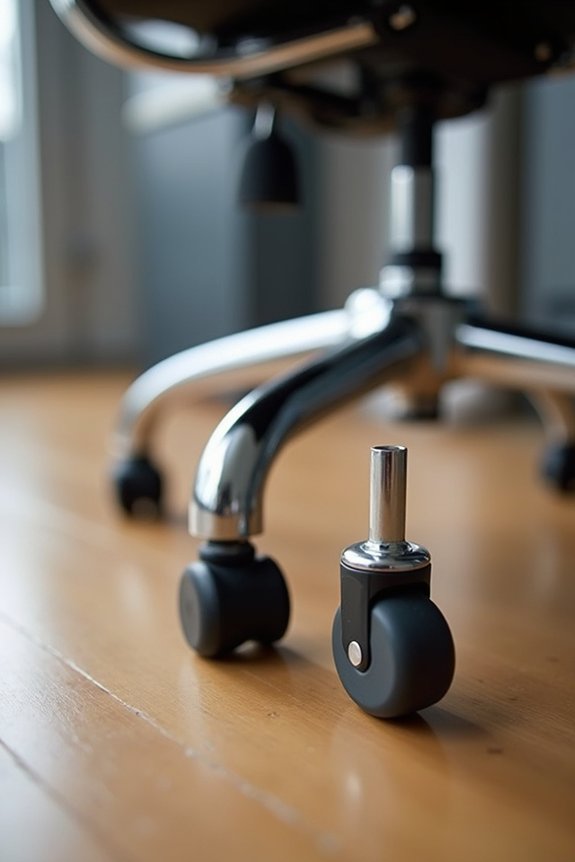
Removing your office chair’s old wheels requires minimal tools and straightforward technique. I’ll walk you through the removal steps so you can replace your caster wheels efficiently.
- Lay a protective blanket across your workspace to catch debris and prevent floor damage
- Position the chair upside down so the wheels face upward for direct access
- Grasp each caster wheel firmly and pull the stem straight out with steady pressure
- Apply gentle force with a flathead screwdriver to pry stubborn wheels while stabilizing the base
If wheels resist removal, don’t force them—use the screwdriver technique instead. Once extracted, inspect the socket for debris and confirm your replacement caster’s stem size matches the standard 7/16 inch diameter and 7/8 inch length. This verification allows for compatibility and a secure fit for your new wheels.
Install New Wheels: Grip Ring vs. Threaded Stems
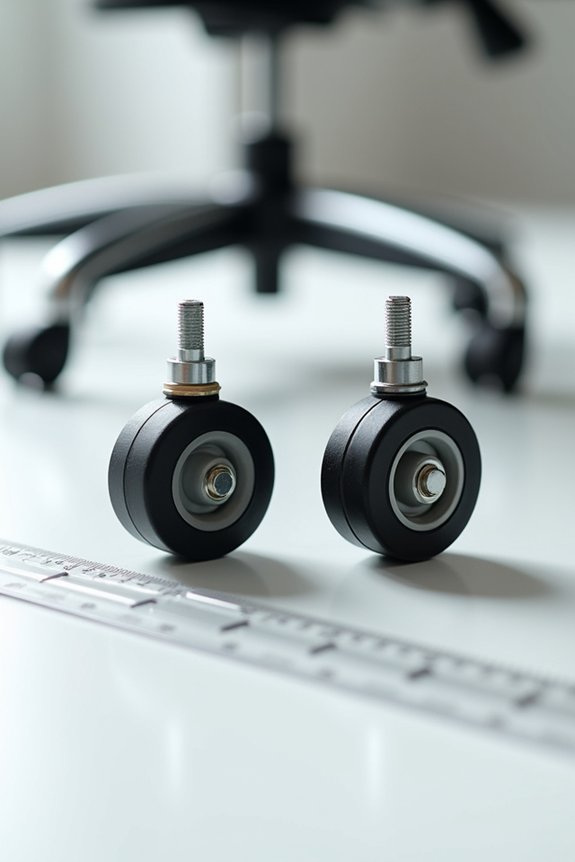
Now that you’ve removed your old casters, you’ll encounter two primary stem designs when installing replacements: grip ring and threaded stems. Each offers distinct advantages depending on your chair’s socket configuration and replacement frequency.
| Feature | Grip Ring Stem | Threaded Stem |
|---|---|---|
| Installation | Push straight into socket until ring snaps | Rotate clockwise into socket |
| Tool Requirement | None required | None required |
| Compatibility | Tolerates universal-fit sockets | Requires matching thread size |
| Replacement Speed | Rapid, tool-free swaps | Slower, requires rotation |
Grip ring stems use metal ring expansion for secure locking without tools. Threaded stems screw into concave sockets for fixed connections. Check compatibility carefully—grip ring designs work better for frequent replacements, while threaded options provide superior stability on permanent installations. Match your socket type precisely to avoid wobble or installation failure.
When Universal Casters Won’t Work for Your Chair

Why don’t universal casters fit every office chair? You’ll encounter compatibility issues when your chair’s specifications deviate from standard dimensions. Here’s what prevents universal wheels from working:
- Non-standard stems (10 mm x 20 mm) that don’t match the typical 7/16 inch diameter and 7/8 inch length
- Wobbling or failed attachment when stems fail to click into bases designed for standard sizes
- Plate-mounted casters requiring specific fastening mechanisms incompatible with stem-based systems
- Brand-specific designs, notably IKEA chairs, engineered for proprietary replacement wheels
Before purchasing universal casters, measure your stem diameter and length. Confirm your mounting type—whether stem or plate-mounted. This verification prevents compatibility headaches and allows proper wheel function. Understanding these specifications helps you select appropriate replacements that secure firmly without wobbling or detachment issues.
Keep Your Wheels Rolling: Cleaning and Lubrication

Once you’ve confirmed your wheels’ compatibility and secured them properly, you’ll want to maintain them regularly. I recommend removing caster wheels from your chair to access debris effectively. Use tweezers or scissors to eliminate hair, string, and tape wrapped around the axle. This debris restricts smooth rolling and shortens caster lifespan substantially.
Next, I apply a gentle cleaning solution with a rag or toothbrush to the wheel, socket, and stem. Dry everything thoroughly afterward. This process removes gum buildup that accumulates from regular use.
Finally, lubrication completes the maintenance cycle. I use light lubricant like WD-40 on all moving parts. This delivers quieter, smoother motion and protects against rust. Regular cleaning and lubrication work together to extend your caster wheels’ functionality and reliability considerably.
Match Wheels to Your Floor Type and Usage Pattern

How well your chair moves depends largely on matching wheels to your specific floor and how you use the chair.
- High-pile carpets require larger wheels, typically 3 inches, for effective roll-over capability
- Hardwood and tile floors benefit from polyurethane wheels that reduce surface wear
- Load capacity matters; heavier users need wheels engineered for sustained weight distribution
- Frequent movers gain durability advantages from polyurethane construction and reinforced wheel design
Your floor type directly influences wheel selection. Softer rubber-like casters minimize friction on delicate surfaces, protecting hardwood finishes. Polyurethane wheels deliver quiet performance across various floor types while maintaining smooth gliding action.
Consider your usage pattern alongside floor type. If you move your chair frequently or carry substantial load capacity demands, select wheels designed for heavy-duty performance. Standard 2-inch wheels work adequately for light use, but increased diameter accommodates carpeted environments more effectively. Matching these factors optimizes chair mobility and floor preservation.