
Yes, rats climb walls effectively using five-toed claws that pierce surface irregularities like grappling hooks, textured paw pads that maximize friction, and muscular leg coordination. Their tails counterbalance body weight during vertical ascent, enabling directional control. Rough surfaces—brick, stucco, concrete block—provide grip; smooth materials like polished glass create impenetrable barriers. Roof rats excel at vertical climbing more than Norway rats. Understanding their climbing mechanics reveals why standard sealing methods fail and what structural vulnerabilities require immediate attention.
Yes, Rats Can Climb Walls: Here’s Why They’re So Good at It

Rats climb walls with remarkable efficiency because they’ve evolved specialized physical features that work together as an integrated climbing system. Their five-toed claws function as grappling hooks, anchoring into surface irregularities. Textured pads on their feet create friction against rough surfaces, enabling secure grip. Long tails provide counterbalance during vertical movement, stabilizing their bodies on unstable terrain. Climbing walls serves specific purposes: accessing warmth, locating shelter, finding food, and establishing nesting sites. Roof rats demonstrate exceptional climbing proficiency, frequently inhabiting roofs and wall cavities through superior agility. Norway rats climb competently but exhibit less adaptability on textured surfaces. Rough surfaces like pebble dash or breeze block substantially improve climbing walls ability, offering enhanced grip compared to smooth finishes. These physical adaptations make rats formidable climbers across varied architectural environments.
Why Rats Can Climb: Sharp Claws and Textured Paws
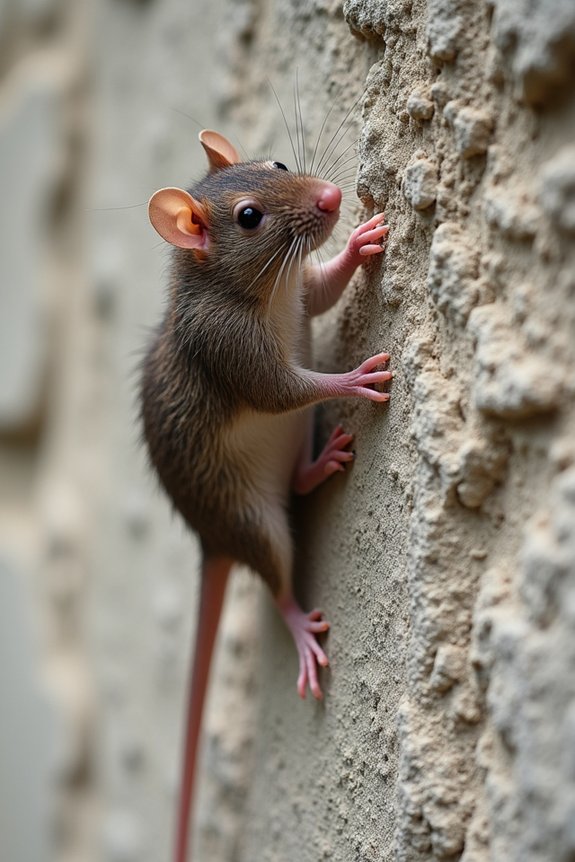
The climbing ability of rats stems from specialized anatomical features that function as an integrated system. Their physical adaptations enable vertical navigation through several key mechanisms:
Sharp claws: Five-toed feet have curved, pointed claws that function as grappling hooks, piercing and gripping rough surfaces effectively
Textured paw pads: Friction-enhancing pads increase traction on brick, stucco, wood, and siding materials
Muscular coordination: Their legs generate sufficient force to maintain grip while ascending
These features work together systematically. The sharp claws penetrate surface irregularities, anchoring the rat’s body weight. Simultaneously, textured paws distribute pressure across contact points, maximizing friction. This dual-mechanism approach allows rats to scale vertical obstacles efficiently. Very rough surfaces like pebble dash enhance their gripping capability considerably, offering more surface area for claw engagement.
How Rat Tails Enable Vertical Wall Climbing
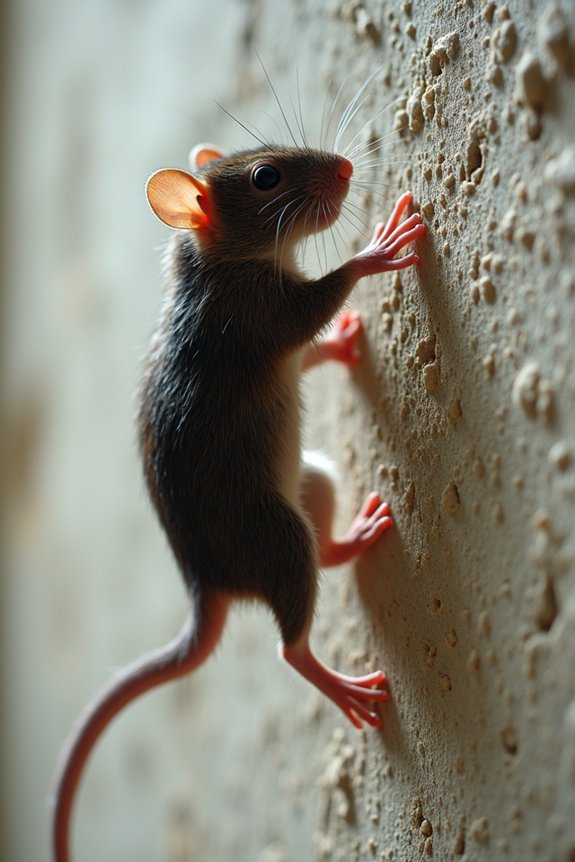
A rat’s tail functions as a counterbalance mechanism during vertical ascent, distributing weight and preventing backward toppling. I’ve observed that the tail’s length—typically equaling the body’s measurements—extends behind the rat, lowering its center of gravity while claws grip the wall surface. This dual function of balance maintenance and grip enhancement creates a three-point contact system that improves climbing performance on textured surfaces like brick and stucco.
Tail Balance and Stability
How do you think a rat maintains equilibrium while ascending a near-vertical surface? The answer lies in sophisticated tail mechanics that work alongside their physical anatomy.
Your rat’s tail functions as a dynamic counterbalance system. Here’s how tail balance and stability work together:
- Counterweight distribution: The tail shifts position to offset body weight during climbing, reducing strain on forelimbs
- Directional steering: Subtle tail movements guide the rat’s trajectory across textured surfaces without breaking grip
- Center of gravity stabilization: Quick adjustments prevent falls during abrupt directional changes on brick or stucco
The tail’s length and muscular control directly enhance climbing efficiency. When rats navigate challenging wall sections, their tail compensates for grip loss, redistributing weight to safer contact points. This mechanism reduces fall risk substantially. Combined with clawed paws and textured pads, the tail enables smoother vertical progression across irregular building surfaces.
Grip Enhancement During Climbing
Beyond counterbalance alone, rat tails enable grip enhancement through active mechanical participation during vertical ascent. The tail’s musculature works in coordination with claw grip and textured pads, providing stabilization during foothold transitions. When rats shift their body weight between climbing positions, the tail adjusts position to maintain contact pressure against wall surfaces. This active steering prevents slips on rough textures by distributing lateral forces away from the primary grip points. The tail’s length allows rats to anchor against irregular wall features, creating a three-point stabilization system alongside their claws and pads. While secondary to claw grip itself, the tail’s participation proves necessary for maintaining climbing rhythm. Together, these mechanisms enable efficient vertical navigation on walls where grip alone proves insufficient for sustained ascent.
Which Wall Types Rats Can Actually Climb?

I’ve found that rats exploit wall composition to their advantage, scaling brick surfaces through mortar joints and textured gaps that function as natural footholds. Smooth materials like polished tiles and glass present insurmountable barriers due to their slick surfaces, which prevent the rats’ claws and pads from gaining purchase. Rough textures—whether concrete blocks, stucco, or weathered wood—enable climbing because they offer the grip points and ledges that rats need to ascend vertically.
Brick Walls And Gaps
When you’re evaluating whether rats can scale brick walls, the answer depends considerably on the wall’s surface characteristics and structural features. Brick walls present varying degrees of climbability based on their construction quality and condition.
Rats exploit specific wall features to gain vertical access:
- Textured brick surfaces provide superior grip compared to smooth materials, allowing claws to catch on rough textures and micro-irregularities
- Mortar joints and gaps between bricks create natural footholds and handholds that accommodate rat paws during ascent
- Structural deterioration including cracks, crevices, and loose mortar significantly increases climbability by offering deeper purchase points
However, professionally installed brick walls featuring smooth finishes and tightly sealed mortar joints substantially reduce climbing feasibility. When gaps are minimal and surfaces uniform, rats encounter considerable difficulty maintaining traction. This variation explains why older structures with weathered brick often experience greater rodent access than modern, well-maintained buildings.
Smooth Surfaces Rats Avoid
While brick walls with their irregular mortar joints and textured surfaces give rats plenty of climbing advantages, smooth wall types present an entirely different challenge. I’ve found that polished glass, slick tiles, and smooth interior finishes offer minimal traction for rat claws and textured pads. These surfaces lack the grip necessary for reliable climbing.
| Surface Type | Texture Grade | Climbability |
|---|---|---|
| Polished Glass | Very Smooth | Minimal |
| Glazed Tile | Smooth | Limited |
| Drywall | Slightly Textured | Moderate |
| Stucco | Rough | High |
| Concrete Block | Very Rough | Very High |
Rats avoid these slick surfaces because their claws can’t anchor effectively. Smooth finishes eliminate friction that enables vertical movement. Interior walls typically present fewer climbing opportunities than exterior rough surfaces. Understanding these distinctions helps you identify vulnerable entry points on your property.
Rough Textures Enable Climbing
How do rats successfully scale walls that stop them cold on smooth surfaces? Rough textures fundamentally change climbing dynamics. Their five-toed claws grip imperfect surfaces effectively, while textured pads generate friction needed for vertical ascent.
Materials that enable climbing walls include:
- Brick and wood siding – natural gaps and texture variations provide secure footholds
- Stucco and concrete blocks – porous surfaces offer consistent grip across the wall face
- Pebble dash and breeze block – extremely rough finishes maximize claw engagement and friction
The surface irregularities act as microscopic ladders. Rats navigate these textures by gripping with claws while their pads maintain contact. Smoother materials like polished concrete or sealed surfaces prevent this mechanism entirely. Understanding which rough textures rats exploit helps you identify vulnerable entry points on your property’s exterior.
Walls Rats Can’t Climb: Glass, Tile, and Smooth Surfaces

Why do rats struggle on certain surfaces while thriving on others? The answer lies in surface texture and material composition. Rats can’t climb smooth surfaces like polished glass or glossy tile effectively. These materials lack the grip points their claws require for traction. When rats encounter smooth surfaces, they slip and fall repeatedly. Their claws can’t penetrate or catch on frictionless finishes. Unlike rough surfaces such as brick, stucco, or unfinished wood, smooth surfaces offer no texture for purchase. Even when rats locate rough patches or edges on smooth walls, their climbing remains limited and inefficient. Understanding these limitations helps you create barriers that protect your space. Smooth finishes on interior walls become your first line of defense against rodent intrusion, preventing rats from ascending and accessing upper areas of your property.
Why Rats Climb: Food, Shelter, and Escape

Knowing that rats can’t scale polished glass or tile doesn’t mean your property’s safe from climbing rodents. Rats climb walls with clear objectives driving their behavior. They’re motivated by three primary factors:
- Food access: Climbing reaches pantries, stored goods, and accessible food sources in upper spaces
- Shelter acquisition: Rats seek attics, roof voids, and wall cavities for nesting and protection
- Escape routes: Climbing provides quick exits when threatened on ground level
Once rats identify climbing walls made of brick, wood siding, or stucco, they establish pathways to entry points around roofs, windows, and vents. Their determination means even modest gaps become access routes. Understanding these motivations helps you identify vulnerable areas on your property and implement targeted prevention strategies.
Can Rats Really Reach Upper Floors and Rooftops?
Absolutely—rats can and do reach upper floors and rooftops with remarkable regularity. You’re likely unaware of how efficiently they navigate vertical surfaces. Roof rats (Rattus rattus) excel at climbing exterior walls. Norway rats climb competently but struggle on smooth surfaces. Both species exploit rough textures: brick, wood siding, stucco, and concrete blocks.
| Climbing Advantage | Function |
|---|---|
| Sharp claws | Grip textured surfaces |
| Textured paw pads | Enhance traction |
| Long tail | Maintains balance |
| Short jumping ability | Bridges gaps between features |
| Body flexibility | Navigates tight spaces |
You’ll find they use external routes including cables, ivy, and nearby trees. They access rooftops through gaps, vent covers, and unsealed openings. Understanding these climbing pathways helps you identify vulnerable entry points on your property and implement effective preventive measures accordingly.
Can Roof Rats and Norway Rats Both Climb?

Both roof rats and Norway rats climb walls, but their abilities differ significantly in practical application. Roof rats excel at vertical ascents using their sharp five-toed claws and textured paw pads on rough surfaces like brick and stucco, while Norway rats climb less efficiently and prefer ground-level routes through sewers and structural gaps. Understanding these species-specific differences helps you identify which rat type you’re dealing with and predict their likely entry points into your building.
Species-Specific Climbing Abilities
When you’re evaluating rodent control strategies, you’ll find that climbing capability varies substantially between rat species. Roof rats demonstrate exceptional climbing prowess, while Norway rats possess moderate abilities. Understanding these differences helps you develop targeted prevention measures.
Both species scale walls using identical mechanisms:
- Sharp claws grip rough texture surfaces like brick, wood, and stucco for vertical ascension
- Tails provide balance during maneuvers on irregular or exposed surfaces
- Smooth materials such as polished glass and tiles present significant barriers
In multi-story structures, roof rats access upper levels and roof voids more readily. Norway rats typically utilize ground-level routes, wall cavities, and drainage defects instead. Surface texture remains the critical factor determining climbing success for both species. Recognizing these species-specific climbing patterns enables you to implement appropriate exclusion strategies effectively.
Roof Rats vs. Norway Rats
How markedly do climbing abilities differ between these two species? Roof rats excel at vertical ascent, using their sharp, five-toed claws to grip brick, stucco, and wood surfaces. Norway rats climb competently but struggle on steep vertical planes. Both species navigate wall cavities and exterior routes differently. Roof rats frequent drainage gaps and upper building sections. Norway rats prefer ground-level entries and sewer systems. When climbing aids like ivy, cables, or rough mortar joints exist, both species access higher elevations more readily. Smooth surfaces challenge either rat significantly. In the UK, Norway rats dominate sewer environments while roof rats remain scarce. However, both can reach roofs when proper access points exist. Understanding these behavioral differences helps identify entry routes and infestation patterns specific to your situation.
Behavioral Climbing Differences
Roof rats and Norway rats demonstrate distinct climbing capabilities that directly reflect their species-specific survival strategies and habitat preferences. Understanding these behavioral differences helps identify probable entry points specific to each species in your environment.
Both species rely on different environmental cues when scaling structures:
- Roof rats prioritize vertical ascent using exterior vines, cables, and gutter lines to reach upper levels and roofs
- Norway rats prefer ground-level access through drains, cracks, and wall cavities rather than climbing higher
- Textured surfaces enable efficient climbing for both species, while smooth materials like glass create barriers
Rats climb walls when searching for warmth, shelter, or food sources. Roof rats’ superior climbing ability means they exploit overhead routes more frequently. Norway rats, though capable climbers, favor horizontal pathways requiring less vertical effort. These behavioral patterns determine which entry points each species will target in your specific situation.
The Secret Routes Rats Take Into Your Home
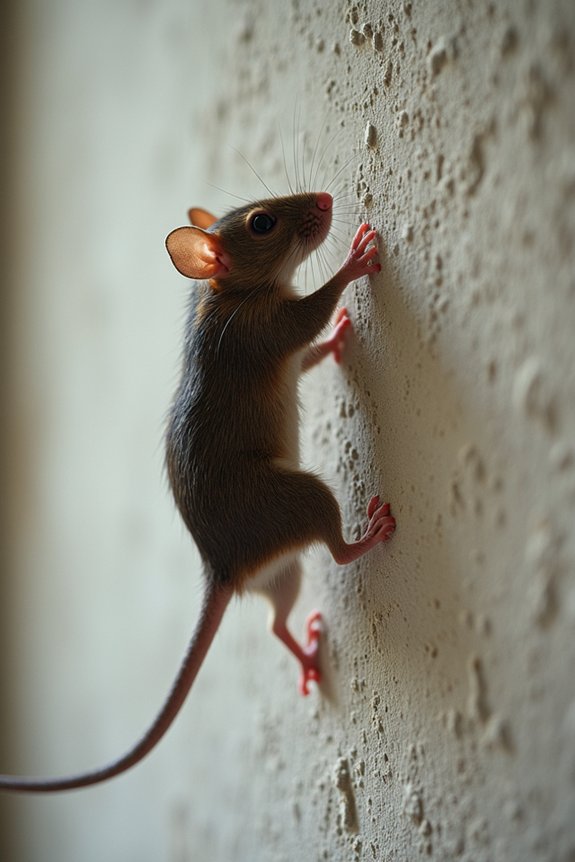
Once rats scale your exterior walls using their sharp five-toed claws and textured foot pads, they’ve already identified their entry strategy. Small gaps around rooflines, windows, and vents become primary entry routes. Nearby trees and ivy provide rapid access to higher levels, accelerating their climb. Once inside, rats navigate internal pathways. Drainage defects create corridors. Wall cavities and box-like pipe runs funnel them toward roof voids and living spaces. These rough surfaces—brick, wood siding, stucco, mortar joints—support their vertical movement. The roof void itself offers darkness and predator-free shelter. Wall cavity openings enable emergence without soffits blocking access. Sealing exteriors alone proves insufficient. Rats occupy wall and floor cavities despite perimeter barriers. Addressing drainage routes first prevents emergence into your living areas.
Which Entry Points Should I Seal First?
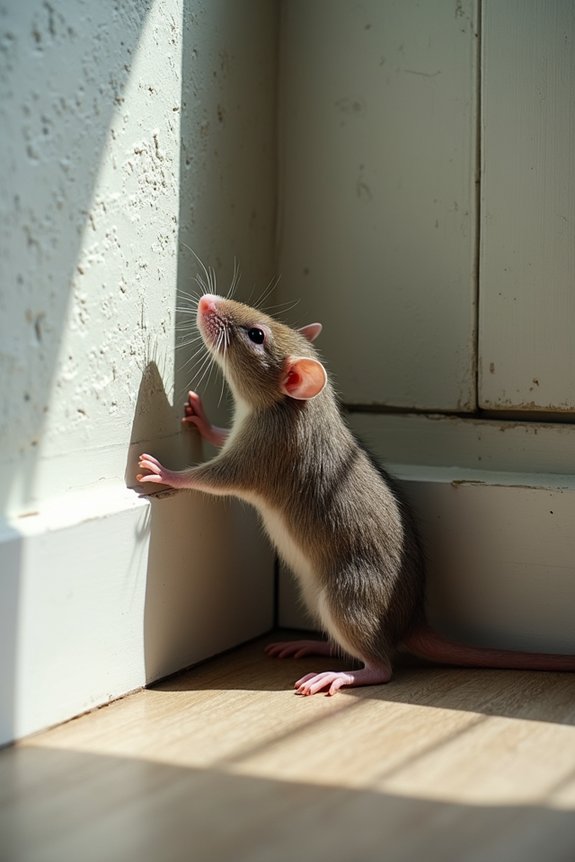
Now that you understand how rats navigate your walls and cavities, you’ll want to stop them before they establish internal pathways. I’ve identified the entry points requiring immediate attention based on rats climbing patterns and access routes.
Stop rats before they establish internal pathways by sealing entry points based on their climbing patterns and access routes.
Prioritize these areas first:
- Roofline gaps and attic vents: Rats commonly enter through high-entry points around roof and wall cavities where unsealed vent covers create direct access
- Window and door frames: Seal small cracks thoroughly since rats squeeze through openings as tiny as a dime in width
- Drainage and pipe openings: Block these with metal mesh or steel wool-backed caulk to prevent access via plumbing and cable routes
Additionally, address foundation gaps and brick seams—these joints often provide overlooked routes into wall cavities. Trim vegetation touching walls to eliminate climbing routes leading to entry points.
Plug the Gaps: Why Metal Mesh Works Better Than Caulk
You’ve sealed the obvious entry points, but gaps remain where pipes penetrate walls, vents protrude from soffits, and foundation cracks create accessible routes. Here’s where metal mesh outperforms caulk. Unlike caulk, which rats gnaw through over time, stainless steel or hardware cloth mesh with 1/4-inch or smaller openings creates an impenetrable physical barrier. Metal mesh resists weathering, UV exposure, and moisture that degrade sealants. You can securely anchor mesh over irregular surfaces and joints, establishing continuous barriers across rooflines and wall cavities. Caulk alone leaves vulnerabilities; metal mesh eliminates them. For persistent or larger rat species, mesh becomes necessary within your integrated pest management plan. This dual approach—identifying gaps first, then blocking them permanently—reduces entry points far more reliably than sealants alone.
Why DIY Solutions Fall Short: When to Call a Professional

How often do homeowners discover their sealed gaps reopened within weeks? Rats adapt quickly to barriers, bypassing incomplete sealant and improperly installed deterrents. DIY solutions frequently fail because they don’t address the full scope of infestation.
Professionals identify hidden routes homeowners overlook:
- Drain defects in foundation areas and under-sink plumbing
- Wall cavities accessible through interior penetrations
- Vent gaps around HVAC systems and exhaust lines
Integrated pest management combines physical barriers, sanitation, and targeted treatments—more effective than traps alone. Professional inspections locate all entry points systematically. DIY traps risk harming children, pets, and non-target wildlife while requiring regulatory compliance. Timely professional intervention reduces re-infestation risk by thoroughly sealing entry points and eliminating moisture and attractants. Long-term cost savings justify the investment.
Integrated Pest Management: The Only Long-Term Solution

While professional sealing stops rats from entering your home, it won’t work permanently without addressing why they’re there in the first place. Integrated Pest Management, or IPM, tackles this by combining prevention, monitoring, and targeted treatments into a coordinated system. You’ll start by eliminating attractants—food sources, water access, clutter—that draw rats inside. Next, you’ll inspect exterior barriers, rooflines, and wall cavities where rats establish harborage. IPM prioritizes physical barriers and sanitation before deploying chemical controls. Regular inspections help you track activity patterns and adjust strategies accordingly. This data-driven approach, coordinated with professionals, creates sustained reduction in rat populations. You’re not just trapping occasional intruders; you’re redesigning your environment so rats can’t thrive there, providing protection that lasts.