No, thermal cameras cannot see through walls. They detect infrared radiation emitted from surfaces, not objects behind barriers. Concrete, brick, and stone resist heat transmission, blocking interior visibility entirely. What thermal imaging actually reveals are surface temperature variations—patterns that indirectly indicate internal conditions like missing insulation or moisture buildup. Glass mirrors infrared energy rather than transmitting it. Thermal cameras excel in darkness and smoke, but remain constrained by barrier properties. Understanding how surface signatures reveal hidden problems requires examining the specific mechanisms at work.
The Short Answer: Thermal Cameras Cannot See Through Walls
How do thermal cameras actually work when pointed at a wall? They detect surface temperature only, not objects behind it. Thermal imaging captures infrared radiation emitted from the wall’s exterior, revealing temperature variations across that surface. You won’t see through walls because most building materials—concrete, brick, drywall, and wood—block heat transmission effectively. Glass, metals, and plastics reflect or absorb infrared radiation, preventing any interior visibility. Heat transfer through wall materials can create surface temperature patterns that thermal imaging interprets as insulation leaks or thermal anomalies. These patterns indicate internal issues indirectly, such as inadequate insulation or pipe locations, but they don’t reveal what’s actually behind the wall. Understanding this distinction helps you use thermal cameras appropriately for detecting surface-level problems rather than expecting direct interior visualization.
Real-World Uses Where Thermal Imaging Excels
While thermal cameras can’t peer through walls, they’re remarkably effective at solving real problems on building exteriors and accessible surfaces. I’ve found thermal imaging delivers practical results when you understand its actual capabilities. Here’s where this technology works best:
Thermal cameras excel at solving real building problems when you understand their actual capabilities and limitations.
- Identifying insulation gaps—surface temperature patterns reveal where interior insulation fails without cutting into walls
- Detecting moisture leaks—water conducts heat differently, creating visible cold spots on exterior surfaces
- Locating hidden pipes and ducts—heat signatures from flowing water or conditioned air show indirect detection through surface temperature variations
- Finding electrical faults—overheating components radiate detectible heat patterns before failure occurs
The key is recognizing that thermal imaging works through indirect detection. You’re reading surface conditions caused by internal heat sources, not seeing through solid barriers. Material properties and temperature differentials determine what becomes visible. This approach requires training, contextual knowledge, and building plans to interpret results accurately.
How Thermal Cameras Actually Work
Thermal cameras detect infrared radiation emitted by objects, then convert this heat energy into electrical signals through specialized sensors. Software processes these signals and displays temperature variations across a color scale, where cooler areas appear blue or purple and hotter areas shift toward red or white. This temperature visualization lets you observe surface heat patterns in real time, revealing thermal differences that your eyes alone cannot perceive.
Infrared Radiation Detection Process
Because all objects above absolute zero emit infrared radiation, thermal cameras capture this invisible energy through a multi-step detection process. I’ll walk you through how this works.
- Radiation emission: Objects continuously emit infrared radiation based on their temperature; warmer surfaces radiate more energy than cooler ones.
- Lens focusing: The camera’s lens concentrates this infrared radiation onto a detector array, creating concentrated energy patterns.
- Signal conversion: The detector converts infrared photons into electrical signals proportional to radiation intensity received.
- Temperature mapping: Processing circuitry translates electrical data into thermograms, displaying surface temperatures using color scales.
Understanding emissivity matters here. Material properties affect how objects emit radiation, influencing reading accuracy. Barriers like walls block or distort infrared transmission, preventing detection of heat sources behind them. You’re measuring surface temperatures only.
Converting Heat Into Images
Your thermal camera’s detector captures infrared radiation emitted by objects and translates it into electrical signals. These signals convert directly into temperature data, which the camera’s processor maps onto a thermographic image. The system uses calibration data and material emissivity values to assign accurate temperature readings to each pixel. Colors represent different surface temperatures—warmer areas appear red or white, cooler areas blue or black. This conversion doesn’t reveal hidden contents behind walls. Instead, it displays only surface temperatures and temperature differences visible to observation. The resulting thermographic image shows thermal patterns across visible surfaces, allowing you to identify heat loss, electrical faults, and moisture problems.
Temperature Visualization And Display
How does a thermal camera translate invisible infrared radiation into an image you can actually see? The process involves several key steps that convert raw sensor data into meaningful visual information.
Your thermal camera’s detector captures infrared radiation emitted by objects and converts it into electrical signals. These signals undergo processing to create a thermogram—a visual representation mapping surface temperature variations across the scene. The camera displays cooler areas in black or blue while hotter regions appear red or white on the color scale.
- Sensor data converts directly to temperature readings through calibration algorithms
- Emissivity values adjust for material-specific infrared emission characteristics
- Color mapping assigns hues based on detected temperature ranges
- Image processing enhances contrast to highlight thermal variations
This visualization system reveals surface temperature differences clearly, enabling you to identify insulation failures, electrical hotspots, and thermal leaks throughout your inspections.
Why Concrete, Brick, and Stone Block Heat Detection
What makes thick masonry walls so effective at stopping infrared imaging? Concrete, brick, and stone reduce emissivity, limiting heat radiation detection. These materials resist heat transmission through their dense structure. Thermal energy from interior sources doesn’t easily penetrate outward to create detectable patterns.
| Material | Emissivity Level | Heat Transmission Rate |
|---|---|---|
| Concrete | Low (0.94) | Slow through density |
| Brick | Moderate (0.90) | Moderate through composition |
| Stone | Low (0.85) | Minimal through thickness |
Insulation layers within walls further block through-wall imaging by trapping heat. Surface temperature variations reflect conduction from pipes or ductwork rather than hidden objects behind barriers. Without breaches or extreme internal heat sources, masonry walls prevent direct thermal penetration. You’ll observe only indirect evidence—hotspots indicating leaks—not interior contents themselves.
What Thermal Cameras Detect Instead: Surface Heat Signatures
Instead of seeing through walls, your thermal camera detects surface temperature variations that reveal heat conduction patterns across the exterior. I can show you how these indirect indicators—like warm spots from internal pipes, cool zones from missing insulation, or thermal gradients around structural defects—manifest visually on the wall’s outer face. These surface signatures tell me about conditions behind the barrier without directly imaging interior contents, making thermal imaging most useful for identifying efficiency problems and material defects rather than seeing hidden objects.
Surface Temperature Variations
The critical limitation of thermal imaging becomes apparent once you understand what these cameras actually detect: infrared radiation emitted from surfaces, not structures hidden beneath them. I’m examining how surface temperature variations function as diagnostic tools rather than transparency devices.
Consider these observable patterns:
- Heat conducts through wall materials, creating warm spots at surfaces where pipes or electrical conduits transfer energy internally
- Insulation defects produce localized temperature inconsistencies across drywall, revealing gaps rather than actual wall composition
- Thermal bridging occurs where building materials with high conductivity bypass insulation, generating visible surface temperature differences
- Low emissivity materials like concrete reduce infrared emission, diminishing surface temperature contrast despite interior heat sources
These variations don’t reveal interior structures. Instead, they map how heat transfers through materials to the outermost layer, allowing thermographers to identify performance issues without penetrating the wall itself.
Heat Conduction Patterns
How do thermal cameras actually capture what happens inside walls without seeing through them? I’ll explain the mechanism. Thermal cameras detect infrared radiation emitted from surfaces, converting it into electrical signals that create thermograms. When internal heat sources—pipes, electrical conduits, or insulation gaps—conduct warmth outward, they alter the wall’s surface temperature. These variations appear as distinct patterns on your thermal display. Material properties matter significantly. Concrete walls, for instance, have low emissivity, reducing infrared emission and making interior detection harder despite surface warming. The resulting image isn’t direct visualization behind the barrier. Instead, it’s an indirect thermal map showing how heat transfers through the wall structure. You’re basically reading surface temperature anomalies caused by interior heat conduction patterns, not viewing hidden contents directly.
Indirect Defect Indicators
- Missing wall insulation creates cooler surface spots where heat escapes through gaps
- Moisture buildup behind drywall produces localized temperature anomalies on interior surfaces
- Studs and framing conduct temperature differently than insulated cavities, showing distinct patterns
- Pipes and electrical conduits transfer heat, creating linear temperature signatures on walls
These indirect indicators guide your investigation. You’ll identify problem areas through surface temperature mapping rather than seeing through solid materials. Wall insulation quality, moisture presence, and structural elements all generate detectable thermal signatures. Thermal imaging reveals conditions through their thermal effects on exposed surfaces, not by penetrating barriers.
How Thermal Imaging Reveals Hidden Problems Inside Walls
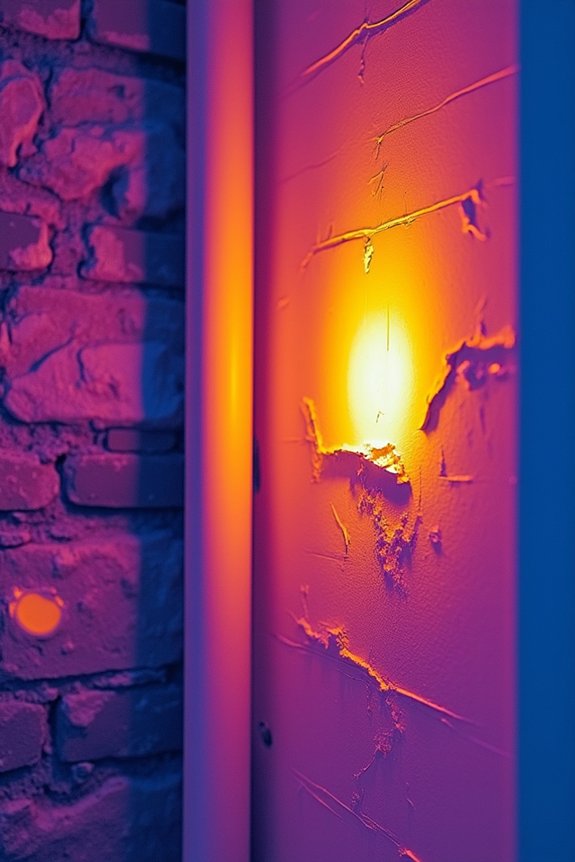
While thermal imaging can’t penetrate walls directly, it detects surface temperature variations that reveal interior problems. I can identify hidden issues by observing how internal heat sources affect exterior wall surfaces. When pipes leak or insulation fails, warmth transfers outward, creating detectable temperature patterns. Drywall shows these changes readily since it conducts heat efficiently. Concrete and brick walls resist heat transmission more effectively, making detection harder but not impossible. I look for thermal anomalies—warmer or cooler spots indicating subsurface conditions. Missing insulation allows heat escape, producing visible cold zones. Leaks generate localized warmth. These surface temperature signatures tell me what’s happening behind the wall without requiring physical penetration. Thermal imaging functions as a diagnostic tool, translating invisible heat into visible evidence of concealed defects.
Glass, Metal, and Wood: Which Materials Block Thermal Vision
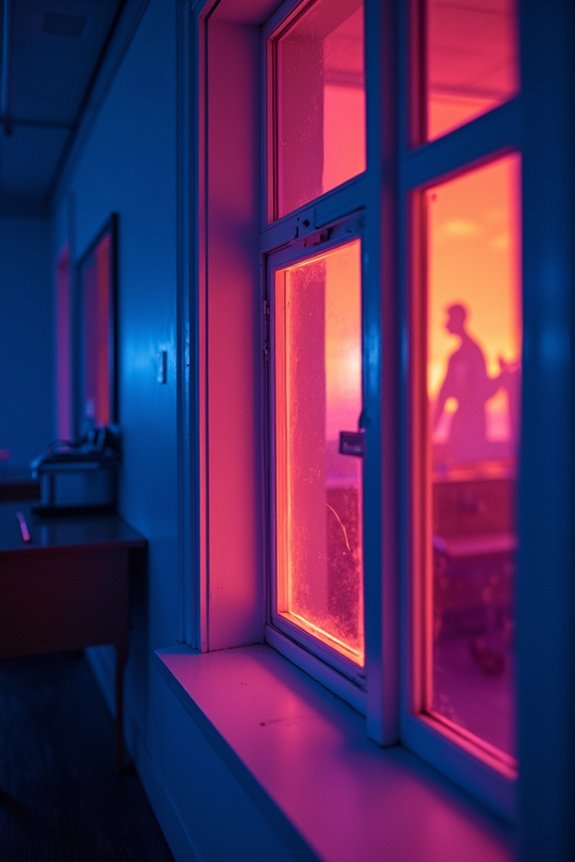
Glass and metal surfaces present fundamentally different challenges when attempting thermal imaging through walls. Glass acts as a mirror for infrared radiation, reflecting heat signatures rather than transmitting them, so you’ll detect only surface temperature or environmental reflections instead of objects behind it. Metal surfaces similarly reflect infrared energy, though oxidized or painted metal can reveal surface heat patterns and localized overheating that indicate underlying problems.
Glass Reflects Infrared Radiation
Reflective barriers like glass present a fundamental challenge for thermal imaging systems. I’ll explain why glass blocks through-wall imaging applications.
When infrared radiation encounters glass surfaces, it doesn’t penetrate—it reflects. This reflection mechanism creates substantial barriers for thermal cameras attempting to see past glass windows or barriers. Here’s what happens:
- Long-wave infrared radiation bounces off glass like visible light bounces off mirrors
- Thermal cameras capture reflected scene imagery instead of objects behind the glass
- Ordinary glass remains largely opaque to infrared transmission across practical wavelengths
- Surface reflections dominate the thermal image, obscuring any heat signatures beyond the barrier
The infrared reflection property means you’ll detect only surface temperatures and reflected thermal patterns, not actual heat sources positioned behind glass. This fundamental physics prevents meaningful through-wall imaging through standard glass barriers in real-world applications.
Metal Surfaces Mirror Heat Signatures
Metal presents a distinct thermal imaging challenge due to its reflective properties. Polished and shiny metal surfaces function as infrared mirrors, blocking wall penetration entirely. These reflective surfaces bounce heat signatures rather than absorbing them, preventing thermal cameras from imaging through metal barriers.
| Metal Type | Surface Condition | IR Reflection Rate | Thermal Imaging Capability |
|---|---|---|---|
| Polished Steel | Shiny | 90-95% | Cannot penetrate |
| Painted Metal | Matte | 60-75% | Surface detection only |
| Oxidized Metal | Dull | 70-85% | Limited surface patterns |
| Brushed Aluminum | Semi-polished | 80-90% | Reflects most radiation |
Oxidized or matte-painted metal surfaces reveal surface heat differences more readily than polished variants. However, neither permits infrared reflection imaging through the material itself. Thermal detection is limited to exterior temperature variations, not hidden objects behind metal walls.
Thin Plastic and Other Barriers Thermal Can Penetrate
How thin does plastic need to be before infrared radiation passes through it? I’ll explain the mechanics of infrared transmission through barrier materials and what you’ll observe.
Thin plastics—like standard bags or sheets under 0.5mm—allow IR wavelengths to penetrate, revealing heat behind barriers. Thick plastics block most transmission entirely. Here’s what determines visibility:
Thin plastics under 0.5mm allow infrared wavelengths to penetrate, while thick plastics block most thermal transmission entirely.
- Thickness directly controls IR penetration; thinner barriers transmit more radiation
- Specific wavelengths transmit differently depending on plastic composition and density
- Surface temperature patterns on the barrier itself indicate hidden heat sources
- You won’t see through to the object—you’ll infer its presence from thermal signatures
This distinction matters: infrared imaging detects surface temperature patterns rather than providing transparent views. Reinforced or opaque plastics block thermal observation completely. Understanding these limitations helps you recognize when infrared imaging becomes unreliable for barrier assessment.
Smoke, Fog, and Darkness: Where Thermal Detection Excels
Where visible light fails entirely, infrared imaging persists—detecting heat signatures in complete darkness without requiring ambient illumination. Thermal cameras excel precisely where conventional vision collapses. In smoke-filled environments, infrared radiation penetrates more effectively than visible light because soot particles scatter longer wavelengths less severely. Heat patterns remain detectable even as smoke density increases, though performance degrades gradually. Darkness presents no obstacle; thermal sensors simply register temperature differences. Fog and rain do scatter infrared radiation, reducing range and image clarity substantially. However, longer wavelengths suffer less degradation than shorter ones. In firefighting scenarios, thermal detection locates hot spots and victims by capturing residual heat when visibility approaches zero. This capability fundamentally distinguishes thermal imaging from visible-light alternatives in extreme conditions.
How Professional Thermographers Diagnose Problems From Surface Data
Professional thermographers don’t actually see through walls—they read the thermal signatures that surfaces reveal. I interpret surface temperature data by comparing heat patterns across building exteriors and interiors. This diagnostic approach relies on several core techniques:
- Material property analysis—evaluating how different substances emit and transmit infrared radiation based on emissivity values and thickness
- Temperature differential mapping—identifying insulation failures and heat transfer anomalies through surface variations
- Spatial pattern recognition—correlating thermal imaging data with architectural plans to pinpoint hidden defects
- Environmental calibration—controlling ambient conditions and validating measurements against expected thermal behavior
I don’t penetrate structural barriers. Instead, I detect how heat transfer through walls, concrete, and insulation manifests at accessible surfaces. By studying these thermal signatures systematically, I locate air leaks, moisture indications, and equipment overheating without direct interior access. Surface data becomes diagnostic when properly interpreted.
Critical Limitations: When Thermal Imaging Won’t Work
Thermal imaging reaches its hard frontiers when materials block heat transmission to the surface. Stone walls—concrete, brick, and similar masonry—absorb and dissipate infrared radiation effectively, preventing interior detection. Wall insulation compounds this limitation by creating thermal barriers that restrict heat flow outward. Consumer thermal cameras cannot recover images of hidden objects inside thick walls.
Through-wall detection remains impossible under standard conditions because infrared radiation cannot penetrate dense materials. Surface temperature variations may indicate leaks or equipment malfunction, but these anomalies don’t reveal what’s behind the barrier. Emissivity and material thickness determine whether heat escapes detectably.
Thermal imaging diagnoses surface conditions only. Specialized military or industrial equipment exists for deep interior applications, yet consumer-grade cameras lack this capability. Accept these technical boundaries when planning your thermal assessments.
Finding the Right Thermal Camera for Your Application
How do you match a thermal camera’s specifications to your actual detection needs?
I recommend evaluating your application against these key factors:
- Resolution and sensitivity: Higher megapixel counts reveal surface temperature variations necessary for identifying through-wall limitations and hidden heat sources.
- Material compatibility: Select cameras that compensate for emissivity values of your target surfaces—concrete, brick, and drywall each require different settings.
- Temperature range: Match the camera’s detection range to your expected surface temperature differentials for accurate thermography best practices.
- Lens selection: Wider fields capture broad areas; telephoto lenses isolate specific heat patterns through thermal imaging analysis.
Understanding through-wall limitations means choosing equipment that excels at detecting surface temperature anomalies rather than expecting penetration capabilities that don’t exist. I verify specifications against your inspection goals before purchasing or renting any thermal camera system.