Yes, blackout curtains reduce heat, but thermal lining matters more than fabric thickness. Dense fabric blocks light; 3-pass or 4-pass foam backing reflects solar radiation and reduces heat gain by 30–45%. White backing facing the window is critical—dark backing absorbs energy instead. Proper installation with 4-inch side overlap and edge-to-floor sealing eliminates gaps that undermine performance. Fabric alone won’t seal air leaks or conduction through glass. Layering with cellular shades amplifies results. Understanding what actually drives heat rejection reveals why installation quality outweighs product cost.
Do Blackout Curtains Actually Keep Heat Out?
Yes, blackout curtains do keep heat out—but their effectiveness depends entirely on construction and installation. The dense, tightly woven fabric combined with a 3-pass or 4-pass foam lining reflects solar radiation and seals the weave against heat transfer. Thermal linings reduce heat gain by 30-45% compared to unlined alternatives.
However, proper installation matters significantly. You’ll need to seal gaps around sides, top, and bottom—overlapping the center by at least 4 inches and nearly touching the floor. The backing should feature light-reflective material on the room-side with white on the exterior.
Blackout curtains won’t replace energy-efficient windows or weatherstripping, but well-made versions installed correctly deliver substantial heat reduction. They’re a practical, accessible addition to your heat-management strategy.
How Heat Enters Your Room Through Windows
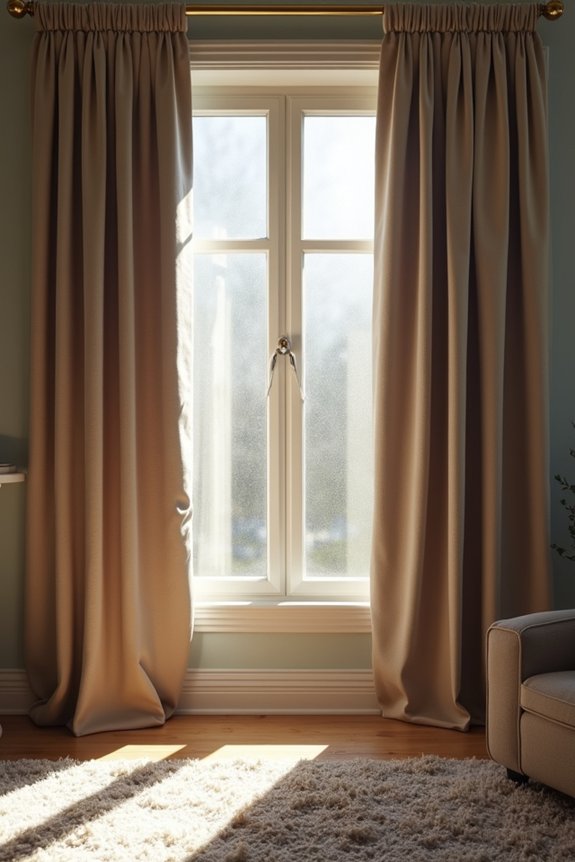
Understanding how heat enters through windows helps you see why blackout curtains work. Heat travels into your room through three primary mechanisms. Solar radiation penetrates the glass directly, warming the air inside—this represents your largest heat gain source. Conduction moves thermal energy straight through the glass material itself, transferring outside temperatures indoors. Air leaks around window frames allow hot or cold air to flow freely, creating temperature fluctuations you’ll notice immediately.
Blackout curtains address these pathways effectively. By blocking sunlight, they reduce solar radiation reaching your room significantly. Their thermal linings and full window coverage slow conduction through the glass. When properly fitted, curtains seal gaps around frames, minimizing air leaks. This layered approach makes blackout curtains a practical solution for controlling indoor temperatures and improving energy efficiency.
Light Blockage Doesn’t Equal Heat Rejection
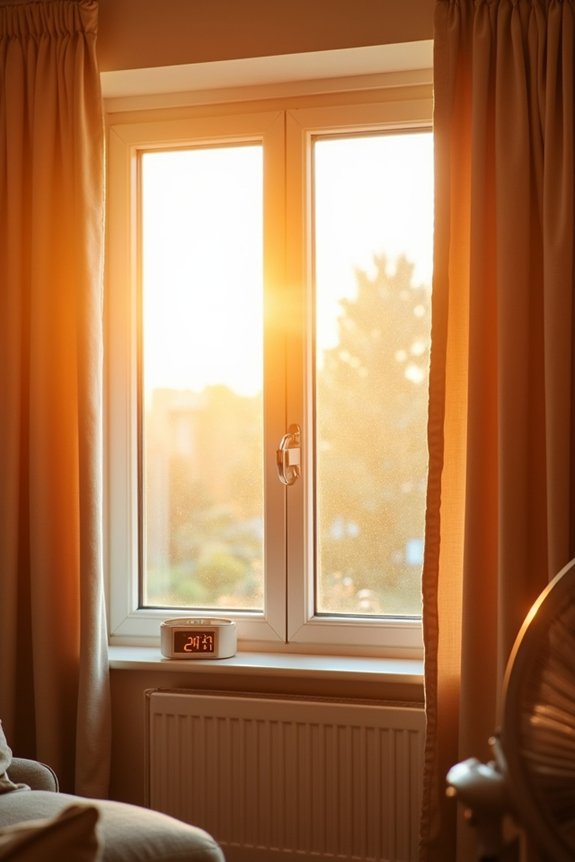
How does a curtain block 100% of light yet still allow heat through? I’ll explain the distinction that changes how you select window treatments.
| Feature | Blackout Fabric Alone | With Thermal Lining |
|---|---|---|
| Light Blockage | 100% | 100% |
| Heat Rejection | Minimal | Significant |
| Lining Type | None | 3-4 pass foam |
| Solar Radiation Reflection | Poor | Excellent |
Thick, dark fabric stops visible light effectively. However, heat travels through infrared radiation—a different energy wavelength. Without a thermal lining, this energy passes straight through the weave. A 3-pass or 4-pass foam backing seals the fabric structure and reflects solar radiation outward. The lining’s light-colored side facing inward bounces heat energy back through your window. Improper installation—gaps at edges or unsealed sections—allows heated air to bypass the curtain entirely. You need both components: blackout fabric plus thermal lining for genuine heat rejection.
Why Thermal Lining Matters More Than Fabric Thickness
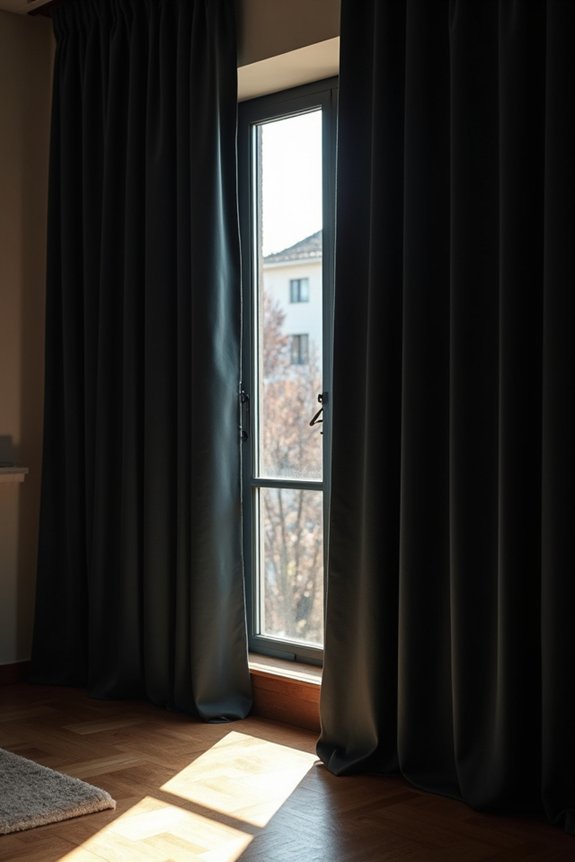
Now that you’ve learned blackout fabric blocks light through its dense weave, you might assume thicker material automatically blocks heat. That’s not accurate. I’ll explain why thermal lining matters more than fabric thickness alone.
Thermal lining—specifically foam or thermal polyester in 3-pass or 4-pass constructions—actually seals the weave and reduces airflow. This construction reflects solar radiation before it heats fabric fibers. A flashlight test reveals the difference: any pinprick of light indicates an open weave allowing heat passage.
Even dark outer fabric won’t perform effectively without proper backing. White or off-white thermal linings reflect the sun’s rays back through windows, reducing heat absorption significantly. Thickness alone can’t accomplish this reflection. The thermal lining’s reflective properties and sealed construction work together to create genuine heat rejection that fabric density cannot achieve independently.
The Color Rule: Why Backing Color Determines Performance
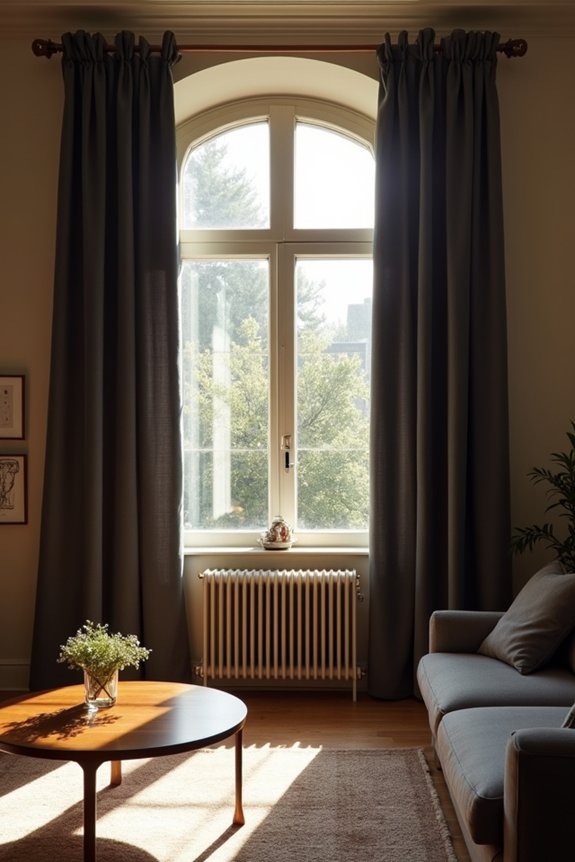
I’ve noticed that most people overlook a critical detail: your blackout curtain’s backing color directly determines whether it reflects or absorbs solar heat. When you position white or off-white backing toward the window, solar radiation bounces back through the glass instead of converting to heat inside your room. If your curtain’s backing matches its dark front color, you’re fundamentally trapping absorbed energy between the fabric and window, creating thermal inefficiency that undermines the entire system.
White Backing Reflects Heat
The backing color you choose—or inherit in ready-made curtains—fundamentally determines how effectively your blackout curtain manages solar heat gain. White backing reflects solar energy back through the window before conversion to heat. This reflective property reduces heat gain significantly. Light-colored backings bounce infrared radiation outward, preventing it from entering your interior space. When you install white backing facing the glass, you’re creating a thermal barrier that works with your curtain’s fabric density. Dark backings absorb energy instead, heating up and creating hot air pockets between curtain and window. Ready-made curtains often feature dark back designs that compromise thermal efficiency. Flipping these curtains aligns backing with front color, optimizing performance. White backing functions as a key component alongside thermal lining, complementing your overall heat-reduction strategy.
Dark Backing Absorbs Energy
While white backing reflects solar radiation outward, dark backing does the opposite—it absorbs that energy and converts it into heat. When you install curtains with a dark backing facing the window, that surface captures incoming light and converts it into thermal energy. This absorbed heat creates a hot air pocket between the curtain and glass, which then radiates back into your room. Black or dark-colored materials, particularly velvet, retain significantly more heat than reflective surfaces. The temperature differential between the backing and room air accelerates heat transfer through convection. This mechanism directly undermines thermal efficiency. For optimal performance, keep your curtains with white backing facing the glass-side consistently. This configuration prevents energy absorption and maintains cooler interior temperatures during peak sun exposure hours.
The Chimney Effect: Why Installation Kills Performance
How often do you consider what happens above and below your blackout curtains? I’ll tell you: improper installation creates a “solar-powered heater” effect that undermines everything you’ve invested in thermal performance. Hot air rises along your walls, escaping through gaps you can’t see. Meanwhile, cool floor air gets pulled upward, heated by the sun, then cycles back down—a continuous loop draining your energy efficiency.
| Installation Point | Gap Size | Heat Loss Impact | Solution |
|---|---|---|---|
| Top edges | 1-2 inches | Highest energy loss | Full wall seal required |
| Side returns | ½-1 inch | Hot air bypass | Overlap 4+ inches minimum |
| Bottom gaps | ¼-1 inch | Cool air circulation | Barely touch floor |
| Center overlap | Misaligned | Complete failure | Precise alignment critical |
Thermal sealing isn’t optional—it’s fundamental to performance. Your hardware, tracks, and alignment determine whether these curtains actually perform or merely look the part.
Hang Them Right: Gap Sealing and Coverage
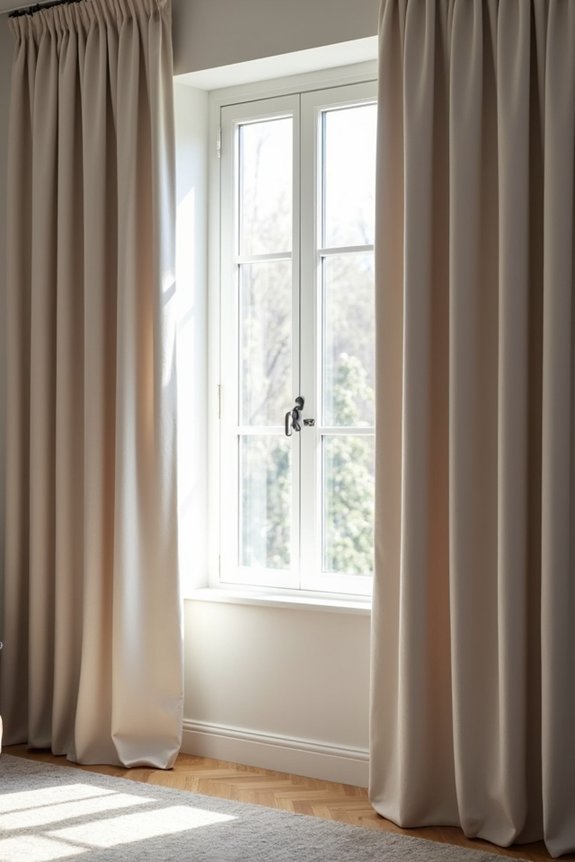
Installation determines whether your blackout curtains deliver thermal insulation or merely decorate. You’ll want curtains that overlap your window frame by at least four inches on all sides. This overlap prevents side air leaks that compromise performance. The fabric should barely touch the floor, eliminating bottom gaps where cooler or warmer air escapes. Returning the curtain rod to the wall matters substantially. When curtains seal against the wall surface, you block the chimney effect—that circulation pattern where hot air rises between glass and fabric. Minimal gaps along edges reduce heat transfer dramatically. Proper gap sealing and full coverage work together, lowering your energy bills considerably. These specifications aren’t optional details; they’re the mechanisms that make blackout curtains function as thermal barriers rather than purely decorative elements.
Non-Vinyl Blackout Curtains: Health and Long-Term Benefits
Vinyl and PVC materials in traditional blackout curtains pose documented health concerns that non-vinyl alternatives eliminate entirely. I recommend considering non-vinyl blackout curtains as a safer long-term investment for your home environment. These curtains achieve complete light blockage through dense fabric construction and optional thermal linings, avoiding chemical off-gassing that vinyl releases over time. You’ll find non-vinyl options across budget ranges, from affordable to premium selections, making health-conscious choices accessible. The backing systems use polyester or cotton blends instead of vinyl layers, maintaining durability without compromising air quality. Installing these curtains properly—with full side coverage and sealed tops—maximizes both heat retention and darkness. Over years of use, non-vinyl blackout curtains won’t degrade or release harmful substances, protecting your family’s wellbeing while delivering consistent thermal performance.
Budget vs. Premium Blackout Curtains: Real Performance Differences
When you compare budget and premium blackout curtains, you’ll notice real differences in fabric density, thermal lining construction, and how effectively they block heat. Premium options typically feature 3-pass or 4-pass foam backing with thermal linings that reduce heat gain by 30–45%, while budget versions rely on standard weaves lacking this insulation technology. Your installation method—overlapping the frame by at least 4 inches and maintaining proper floor contact—matters equally, since even premium curtains lose effectiveness with gaps that let warm air escape.
Fabric Quality And Thickness
How much does fabric construction actually influence heat retention? Thickness matters significantly. Thicker blackout fabrics block heat transfer more effectively than thin alternatives. Premium curtains include thermal linings—foam or dense polyester layers—that reduce convection and radiating heat. Budget options often lack proper lining, compromising performance.
The weave density and lining passes determine real effectiveness. Three-pass or four-pass construction seals light and air gaps more completely. These multiple layers create barriers that thin fabrics simply can’t replicate.
When comparing panels side-by-side, performance differences become apparent. Premium blackout curtains with substantial thickness and reinforced linings outperform budget versions consistently. Budget curtains may feel flimsy, lacking the density needed for genuine heat suppression.
Quality construction delivers measurable thermal benefits for your space.
Thermal Lining Technology Matters
The fabric weave alone doesn’t block heat effectively—thermal lining is what actually stops solar radiation from penetrating your windows. I’m talking about 3-pass or 4-pass foam-backed linings that seal the weave and reflect solar energy before it heats fabric fibers.
Premium blackout curtains combine thicker fabrics with advanced thermal linings, delivering 30–45% heat reduction when properly installed. Budget alternatives use simpler, thinner fabrics with basic lining, offering noticeably weaker insulation and heat-blocking performance.
The difference matters because thermal lining technology directly determines how much warmth enters your space. Premium versions provide superior protection through construction quality and material density. Installation quality amplifies these benefits: complete window coverage, seal side gaps, and overlap floor-to-ceiling to prevent warm air bypassing the fabric entirely.
Installation Impact On Performance
Premium thermal linings alone won’t deliver advertised heat reduction if your curtains hang improperly—installation quality determines whether that 30–45% performance gain actually reaches your space. I’ve found that proper coverage requires curtains extending at least 4 inches beyond the window center, with fabric edges meeting to eliminate side gaps where heat transfers directly through. The bottom edge must touch the floor, sealing the gap where rising warm air typically escapes. Budget curtains installed correctly often outperform premium options hung carelessly because installation gaps undermine even superior thermal lining technology. Dense blackout fabric with thermal lining backing performs optimally only when coverage is complete. You’re investing in materials that function effectively only through precise, deliberate hanging that eliminates heat pathways entirely.
Cellular Shades vs. Blackout Curtains: When to Choose Each
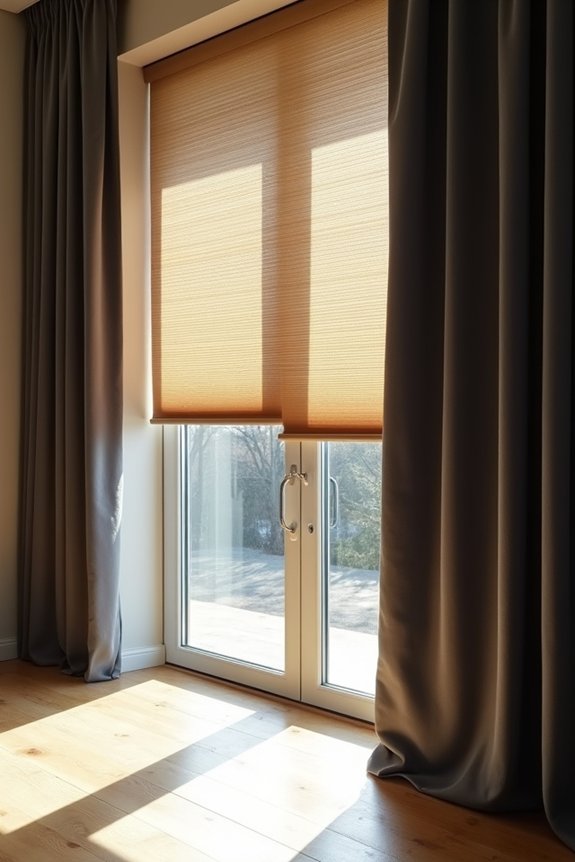
Choosing between cellular shades and blackout curtains depends on your specific priorities: light control, thermal performance, aesthetic preference, and installation constraints.
| Feature | Cellular Shades | Blackout Curtains |
|---|---|---|
| Light Blocking | Partial to complete | 100% blackout fabric |
| Thermal Lining | Honeycomb air pockets | 3-pass/4-pass foam backing |
| Heat Rejection | Moderate efficiency | Superior with proper installation |
| Installation | Inside or outside mount | Requires 4-inch side overlap |
| Aesthetic Impact | Minimal visual footprint | Statement window treatment |
Blackout curtains are the better choice when you prioritize maximum darkness and heat rejection simultaneously. Their thermal linings reflect solar radiation effectively. Cellular shades work better for minimalist aesthetics and easier installation. Consider your room’s existing décor, window dimensions, and whether you’ll commit to proper side sealing for optimal performance.
Solar Roller Shades vs. Blackout Curtains for Heat Control
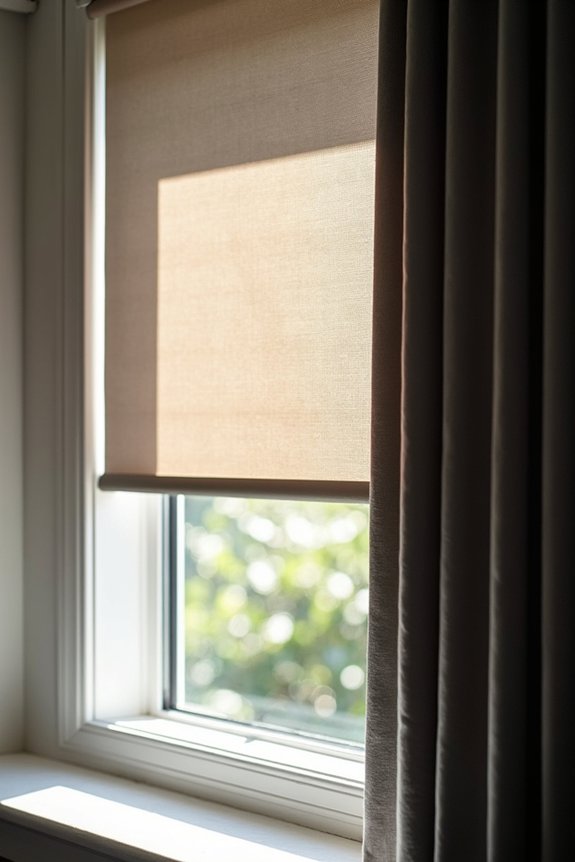
When it comes to managing solar heat gain through windows, solar roller shades and blackout curtains offer distinctly different performance levels. You’ll find that solar roller shades provide low to medium heat blocking, excelling at glare reduction rather than total heat rejection. Blackout curtains, however, deliver superior thermal control through their dense fabric construction combined with specialized linings.
Here’s what sets them apart:
Solar roller shades excel at glare reduction, while blackout curtains deliver superior thermal control through dense, specialized fabric construction.
- Heat reduction capacity—blackout curtains with thermal lining reduce heat gain by 30–45% in direct sun, significantly outperforming standard solar roller shades.
- Material construction—blackout curtains use triple- or four-pass foamed linings that create superior insulation barriers against outdoor temperatures.
- Installation coverage—curtains that fully cover windows and seal sides prevent heat infiltration more effectively than roller shade alternatives.
Combining both options provides optimal thermal performance.
Layering Blackout Curtains With Other Window Treatments
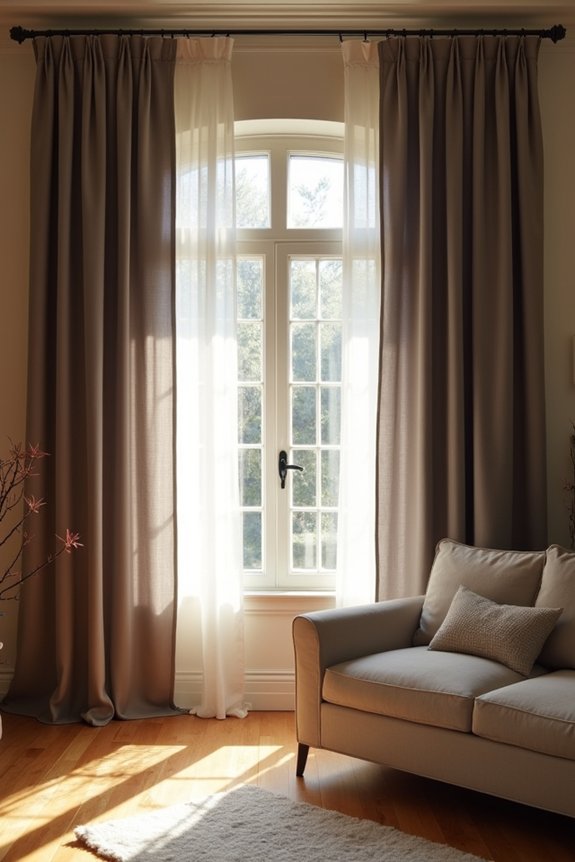
How much thermal performance can you actually gain by combining blackout curtains with secondary window treatments? I’ve found that layering delivers measurable results through complementary mechanisms. Cellular shades trap air in honeycomb pockets, creating insulation with high R-values. Blackout curtains block 100% of light while rejecting heat. Together, they’re more effective than either alone.
I recommend installing cellular shades inside the frame, then positioning blackout curtains outside. This setup seals gaps and minimizes air leakage. Install at least 4 inches of overlap on window sides for maximum coverage. The configuration works particularly well in nurseries and media rooms where temperature stability and darkness matter equally.
This layering strategy combines insulation with light control, addressing your thermal needs comprehensively.
Where Blackout Curtains Fall Short and What Works Better
While layering blackout curtains with cellular shades considerably improves thermal performance, blackout curtains alone have measurable limitations in heat control. You’ll find that fabric blockage, though effective, doesn’t address all heat transfer pathways through windows.
Blackout curtains improve thermal performance, yet fabric alone cannot address all heat transfer pathways through windows.
Here’s where blackout curtains fall short:
- Solar radiation penetration – Triple-pass linings slow heat gain, yet direct sunlight still transfers energy through glass panes before curtains intercept it.
- Air leakage paths – Gaps around window frames and sills allow conditioned air escape; curtains can’t seal structural vulnerabilities.
- Conduction through glazing – Single or double-pane glass conducts heat regardless of interior fabric barriers.
What works better combines approaches: upgraded window films reduce solar transmission, weatherstripping eliminates air leaks, and proper glazing addresses conduction directly. You’ll achieve superior thermal control by pairing blackout curtains with these structural solutions.
Calculate Your Heat Savings: ROI by Climate Zone
Your heat savings depend directly on your climate zone’s solar intensity, window-to-wall ratio, and existing cooling costs. This analysis compares your region’s peak sun hours, average summer temperatures, and annual energy expenses against blackout curtain installation costs. The calculation reveals whether your investment recoups within one to three years or requires longer timelines based on geographic location.
Climate-Specific Savings Potential
In the context of payback calculations or assessing energy savings, understanding your climate zone fundamentally shapes blackout curtain ROI.
Your savings potential shifts appreciably based on local weather patterns and solar exposure. Here’s what you need to know:
- Hot climates with extended summers: Blackout curtains reduce heat gain by 30–45%, creating payback periods of 1–3 years when paired with 3-pass or 4-pass thermal linings that maximize heat rejection.
- Cold climates: These curtains retain indoor heat, lowering heating energy use by 10–25% and extending payback to 3–5 years depending on installation quality.
- Mild climates: Modest energy savings occur, requiring longer investment recovery periods of 5+ years.
Your actual ROI depends on window-to-wall ratios, curtain coverage including overlaps, and whether you layer treatments. Energy costs in your region also determine final payback timelines.
Payback Period Calculator
Calculating your exact payback timeline requires plugging specific numbers into a formula that accounts for climate zone, window dimensions, and curtain specifications. Input your window area in square feet, local heating costs per unit, and thermal efficiency ratings of your chosen curtains. The calculator factors installation quality—whether you’re using 3-pass or 4-pass foam linings substantially impacts results. Proper installation, including side overhangs and center overlap, reduces the payback period significantly. In colder climates where blackout curtains reduce heating demand by 25% to 45%, you’ll see faster returns. Ready-made curtains cost $20 to $100+, making payback periods typically 1-3 years depending on your climate zone and window coverage percentage.
Getting Started: Your Blackout Curtain Action Plan

How you install blackout curtains matters more than the product itself. I’ll walk you through the steps that help your investment deliver genuine heat reduction.
Installation technique trumps product quality when maximizing blackout curtain performance and achieving genuine heat reduction benefits.
- Measure your windows precisely, accounting for wall-to-wall coverage that eliminates side gaps where heat escapes.
- Select 3-pass or 4-pass foam-backed lining with white or off-white facing toward glass to reflect solar radiation effectively.
- Install curtains to return to walls, overlap center seams by at least 4 inches, and allow fabric to just touch flooring.
Proper installation seals air gaps that compromise thermal performance. You’ll position your blackout curtains for maximum efficiency, cutting heat gain by 30-45% when combined with correct measurements and positioning. This foundation prepares you for better energy savings throughout summer months.